

Blog
Air Hygiene: Three Pioneers, Two Days, and One Goal

day, air hygiene is considered one of the foundations of modern medicine. It is taken for granted in operating theatres, intensive care units, laboratories, the pharmaceutical industry, and other controlled environments. However, the path toward today’s understanding of air hygiene did not begin with the development of ventilation systems, HEPA filters, or international standards.
Its foundations were laid much earlier, at a time when microorganisms were not yet fully understood and air could not be analyzed using modern instruments. Yet, in the story of the development of air hygiene, two days in August symbolically connect three pioneers of this field.
Two Days in August That Changed the History of Medicine
The history of medicine is filled with remarkable discoveries. It is rare, however, for just two days on the calendar to connect three individuals whose work would fundamentally change the way we think about health, hospital hygiene, and the environments in which patients are treated.
In the history of medicine, 12 and 13 August symbolically unite three people who probably never considered themselves part of the same story and whose lives never crossed.
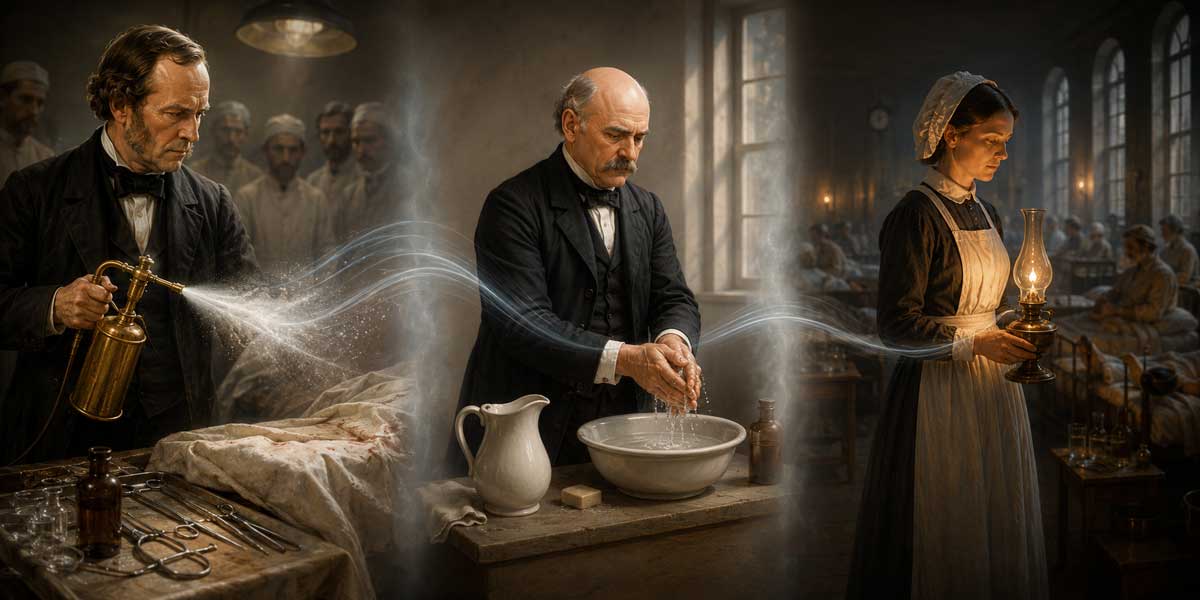
Each of them addressed a different problem. One focused on the hospital environment. Another studied the transmission of disease. The third transformed surgical practice. Today, we know that each of them, in his or her own way, contributed to the understanding of what we now call air hygiene.
Air Hygiene and the Beginning of Antiseptic Surgery
On 12 August 1865, the Scottish surgeon Joseph Lister performed an operation on an eleven-year-old boy using an antiseptic technique. The boy had suffered a severe compound fracture of his leg. At that time, injuries of this kind almost invariably resulted in amputation or death from infection.
Lister’s antiseptic procedure proved successful. The boy recovered, and this event marked the beginning of a new era in surgery. It was a turning point that would soon confirm that the observations of Ignaz Semmelweis had been far ahead of their time.
Lister subsequently extended his antiseptic approach to wounds, surgical instruments, the operating field, and even the air within the operating theatre. The spraying of carbolic acid represented the first documented attempt at chemical air disinfection in the history of medicine.
A Profound Historical Injustice
Only one day later, on 13 August 1865, Ignaz Semmelweis died.
The man who had spent years trying to convince his colleagues that simple hand hygiene could save thousands of lives did not live to see medical practice confirm the fundamental principle for which he had fought. The irony of history was even greater: he died of a systemic infection – the very condition against which he had devoted most of his professional life.
Exactly forty-five years later, on 13 August 1910, Florence Nightingale also passed away.
Thus, just two dates on the calendar symbolically connect three pioneers whose ideas continue to shape the way we think about hygiene, infection prevention, and the quality of the hospital environment.
Three Different Paths Toward the Same Goal
At first glance, Joseph Lister, Ignaz Semmelweis, and Florence Nightingale worked in completely different fields.
Their methods differed, as did the problems they sought to solve. Even their conclusions were reached under entirely different circumstances. Yet all three were trying to answer the same question: What can we change in the patient’s environment to save more lives?
Today, this question seems perfectly natural. In the mid-nineteenth century, it was revolutionary.
-
Joseph Lister – When Theory Became Practice
Unlike Florence Nightingale and Ignaz Semmelweis, Joseph Lister was not primarily known for statistical analyses. His greatest contribution was transforming emerging scientific knowledge into practical medicine.
Inspired by Louis Pasteur’s work on microorganisms, Lister concluded that infection was not an inevitable consequence of surgery. If microorganisms could be prevented from entering a wound, infection could also be prevented.
He began using carbolic acid to antiseptically treat wounds, surgical instruments, and the operating field. Later, he even attempted to disinfect the air by spraying carbolic acid throughout the operating theatre.
From today’s perspective, it is clear that this was not the ultimate solution. Nevertheless, it represented the first serious effort to regard the air in a healthcare environment as a factor capable of influencing clinical outcomes.
Lister did more than embrace a new scientific concept. He demonstrated that it could be successfully applied in everyday medical practice.
SEE ALSO: Lord Lister and the First Chemical Air Disinfection
-
Ignaz Semmelweis – When the Numbers Spoke
While Florence Nightingale was studying the hospital environment, Ignaz Semmelweis was trying to understand why maternal mortality was dramatically higher in one maternity ward than in another.
He did not begin with a theory but with careful observation and analysis of numerical data. He compared outcomes, searched for differences, and rejected assumptions that were inconsistent with the evidence. After introducing mandatory hand disinfection, maternal mortality declined dramatically.
Today, hand washing seems self-evident. However, in the middle of the nineteenth century, it represented one of the greatest revolutions in the history of medicine.
Semmelweis had no access to modern microbiology. He could not measure aerosols. He knew nothing about PM₂.₅, VOCs, or HEPA filtration. Yet he understood something far more fundamental. He reached a conclusion that would permanently change medical practice: The chain of disease transmission can be broken.
That principle remains just as important today.
SEE ALSO: Ignaz Semmelweis: The Savior of Mothers and Newborns
-
Florence Nightingale – When the Hospital Became Part of the Treatment
Florence Nightingale did not view the hospital merely as a place where patients were treated. She regarded it as an integral part of the healing process itself.
During the Crimean War, she encountered overcrowded hospital wards, inadequate ventilation, poor sanitary conditions, insufficient natural light, and inefficient organization of care. Rather than accepting these conditions as inevitable, she began to observe, record, and compare the outcomes.
She did not believe assumptions. She believed data. Her statistical analyses demonstrated that improvements in sanitary conditions – including better ventilation and access to fresh air – were accompanied by a significant reduction in mortality.
At a time when the role of microorganisms was only beginning to be understood, Florence Nightingale demonstrated that the environment surrounding the patient could have a decisive influence on treatment outcomes.
SEE ALSO: Florence Nightingale’s Lamp Brings a Glimmer of Hope
What Truly Connected These Three Pioneers?
Their contributions to hygiene and the hospital environment took different forms:
- Lister transformed surgical practice.
- Semmelweis interrupted the transmission of infection through hand hygiene.
- Nightingale transformed the entire hospital environment.
What united them was their way of thinking. They noticed what others overlooked, measured outcomes, and trusted evidence more than established beliefs. Then, based on those findings, they changed medical practice.
This is precisely how modern air hygiene solutions are developed today.
The process does not begin with the assumption that a particular technology is the best. It begins with the problem itself – with understanding the sources of contamination, the potential routes of transmission, and the desired outcome. Only then is the appropriate solution selected.
Air Hygiene Today
Since the time of these pioneers, medicine has made extraordinary progress. International cleanroom standards have been established. Ventilation systems have become increasingly sophisticated. High-efficiency filtration, indoor air quality monitoring, and numerous technologies for further improving air quality have been developed.
Today, air hygiene is no longer limited to reducing the presence of microorganisms.
It encompasses the control of airborne particles, chemical pollutants, and unpleasant odors; the provision of appropriate ventilation and airflow patterns; and the prevention of unwanted pathways of contamination between different areas.
The COVID-19 pandemic served as a historic reminder that air is more than simply the medium in which we exist. Under certain conditions, it can also become an important route for the transmission of infectious aerosols.
At the same time, numerous scientific studies have further highlighted the importance of air quality for overall health, including respiratory diseases, cardiovascular health, mental well-being, reproductive health, and many other aspects of human health.
Examples from Contemporary Practice
Today, these historical lessons have very practical applications.
For more than three decades, Marquis Intelligence has participated in the design and implementation of air quality improvement solutions across a wide range of facilities, including healthcare institutions.
These projects include the Institute for Cardiovascular Diseases of Vojvodina in Sremska Kamenica, the Clinical Centre of Vojvodina in Novi Sad, the Institute of Public Health of Montenegro in Podgorica, as well as numerous other public and private healthcare facilities.
Interestingly, the implementation of one of the advanced air treatment technologies in healthcare facilities began with education.
From Education to Practical Implementation
During a professional presentation organized by Marquis Intelligence on advanced technologies for improving air hygiene, a consulting engineer involved in the design of the Clinical Centre of Vojvodina attended the event.
Interested in the potential application of dielectric barrier discharge (DBD) technology within ventilation systems, he invited the Marquis Intelligence engineering team to deliver an additional presentation at his design office. Shortly thereafter, another presentation was organized for representatives of the healthcare institution itself.
Following the official opinion issued by the competent professional authority, a decision was made to implement this technology within the central ventilation systems of the new hospital building.
The journey from a new idea to its practical application has changed very little over the past century and a half.
Even today, progress depends on professional dialogue, scientific evidence, openness to new knowledge, and the willingness to improve established practice.
SEE ALSO: Mini Case Study: Impeccably Clean Air in a Hospital in Novi Sad
Today, We Continue to Ask the Same Question
Florence Nightingale, Ignaz Semmelweis, and Joseph Lister did not have access to modern instruments. They could not measure PM₂.₅ concentrations or monitor indoor air quality in real time. High-efficiency filtration systems and international cleanroom standards did not yet exist.
Nevertheless, they possessed what remains the foundation of all serious science and engineering:
- they observed carefully;
- they asked questions;
- they monitored the results;
- they changed practice when evidence demonstrated that a better solution existed.
Perhaps that is precisely why the symbolism of 12 and 13 August remains so powerful.
Within the span of just two days on the calendar, history forever linked three individuals who demonstrated that health depends not only on the medicine we practice, but also on the environments we create.
At Marquis Intelligence, we continue to work according to the same principle.
It is not enough simply to deliver air into a room. We must understand how it behaves, how it moves, and how it affects the people who breathe it.
Perhaps this is the most enduring message shared by Florence Nightingale, Ignaz Semmelweis, and Joseph Lister.
This article is part of the “Learn More About Air Through History and the People Who Shaped It” series from the Marquis Intelligence Archive.Document ID: MI-LAH-013.26 – Air Hygiene: Three Pioneers, Two Days, and One Goal
