

Blog
Clean Air Heals: Florence Nightingale

Shaping a Legacy
Florence Nightingale, known as “The Lady with the Lamp,” revolutionized healthcare and set the foundation for modern ventilation and public health standards, but she also improved statistical science. She demonstrated that clean air heals, while polluted hospital air takes lives. Her pioneering efforts continue to inspire professionals and reformers across generations, profoundly impacting hospitals, healthcare systems, and society.
Early Life and Education
Florence Nightingale was born on May 12, 1820, in Florence, Italy, after which she was named. Her father ensured she received an unusually high-level classical education, especially for women of her time. She excelled in German, French, Italian, philosophy, and statistics. From a young age, she dedicated herself to helping the poor and sick in her community. At just 16 years old, she felt a divine calling to pursue nursing. Despite societal expectations and her parents’ opposition, she pursued her vocation.
A Revolution in Ventilation and Hygiene: Clean Air Heals
During the Crimean War, Nightingale recognized the critical link between ventilation, hygiene, and health. The overcrowded and unsanitary conditions in hospitals at Scutari led to high mortality rates among soldiers. She dramatically reduced mortality rates by implementing advanced measures, including improved air circulation and waste management.
Her observations were not just theoretical; she proved that clean air aids patient recovery. Using serious statistical analysis, she demonstrated how enhanced natural ventilation reduced death rates. She even recommended specific amounts of fresh air needed per patient.
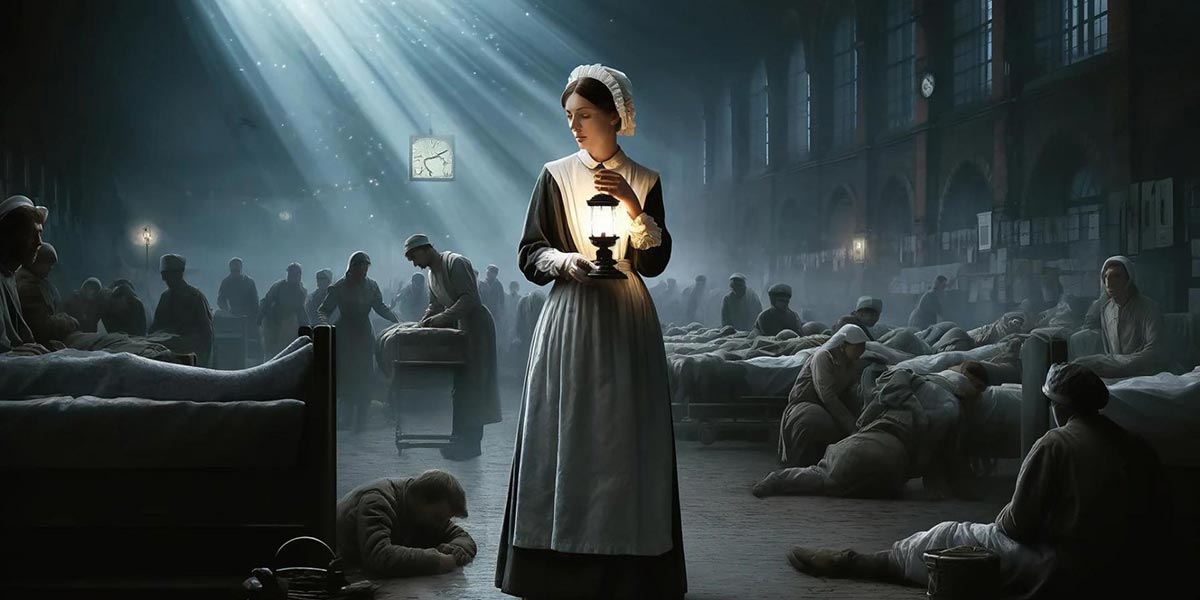
Florence earned her iconic title, “The Lady with the Lamp”, by tending to wounded soldiers at night, bringing comfort and hope. Her reforms extended beyond patient care. She established kitchens for patients’ dietary needs, ensured clean bedding, and even introduced libraries to engage patients mentally. Interestingly, both clean air and reading positively affect mental health and recovery.
>>ALSO READ: How Air Pollution Affects Our Brain?
The Threefold Effect of Florence Nightingale’s Lamp
With her open-flame lamp, Florence Nightingale gave patients more than comfort and hope. Her small lamp had a threefold effect.
The first was psychological. The lamp illuminated the space and created a sense of safety and hope. This had a strong impact on the mental health and recovery of wounded soldiers.
The second was physical. The flame burned part of the airborne microorganisms and thus contributed, unknowingly, to hospital hygiene.
The third, almost invisible at the time, was the ionic effect. Every flame releases ions, which help further purify the air.
Flame as a Source of Ions
The ancient Greeks recognised four basic elements: earth, water, air, and fire. Much later, science identified three states of matter. Solid, liquid, and gas. Later, a fourth was added: plasma. Each element connects to one state of matter: earth with solid, water with liquid, and air with gas. And fire? Fire links to plasma because the flame is a strong natural source of ions, and ions make plasma.
Ions produced by a flame have lower energy levels, but they are still ions. In this way, even without knowing it, Florence Nightingale’s lamp contributed to cleaner hospital air. Her lamp opened a symbolic bridge to today’s ionization technologies that improve air quality in healthcare facilities.
Ions Still Safeguard Hygiene Today
On the same principles, Marquis Intelligence has completed many projects in healthcare institutions. During the reconstruction of the Cardiac Surgery Clinic in Niš, for example, our team installed dielectric barrier discharge equipment on silver-coated glass tubes across all three ventilation systems in operating rooms. This ensured a higher level of air hygiene.
The same approach was applied in the new buildings of the Clinical Centre in Niš, with more than 20 central systems treated with this technology. These projects confirm that clean hospital air is not only a legal obligation but also a strategic commitment for institutions that aim to provide the highest standard of health and safety.
Similar advanced air treatment principles have also been applied in many other healthcare facilities across the region. Among them, the Institute of Public Health in Podgorica, Montenegro, stands out as the first to adopt such solutions to provide additional protection for both patients and staff.
Statistics Confirmed That Clean Air Heals
A true pioneer in applying statistics, Florence Nightingale used polar area diagrams, known as “Nightingale rose diagrams,” to illustrate the causes of mortality in military hospitals visually. Learn more about the Nightingale Rose Diagram. These tools helped lawmakers and public officials understand the need for preventive measures, leading to widespread healthcare reforms. She was the first woman admitted to the Royal Statistical Society and an honorary member of the American Statistical Association.
Enduring Contributions
Florence Nightingale’s advocacy for clean air, proper ventilation, and sanitary reforms laid the foundation for modern healthcare standards. Her influence extended to military and civilian hospitals and public health initiatives in India, where her efforts significantly reduced mortality rates, reinforcing the principle that clean air heals.
A Timeless Reminder
Almost 200 years ago, this extraordinary woman understood and proved the critical importance of ventilation in preventing the spread of microbial aerosols. It took a global pandemic to bring back the focus on infectious aerosols, yet Florence Nightingale had already laid the groundwork.
>>ALSO READ: New ASHRAE Standard 241: Control of Infectious Aerosols—Guidelines for Ventilation Systems
Clean air is fundamental for a healthy life. Unfortunately, many people still fail to grasp the full health implications of air quality. According to Harvard University statistics, urban dwellers spend 65% of their lives indoors. Hence, the quality of air in our homes has a significant impact on our quality of life and overall health. Yet, most still see home ventilation as a luxury rather than a necessity for health.
>>ALSO READ: The Importance of Indoor Air Quality in Our Homes
Do you believe ventilation should be considered a necessity rather than a luxury in every home? Contact us to learn how Marquis Intelligence can transform your space into a healthier environment.
Inspiring Generations
Florence Nightingale demonstrated how passion, knowledge, and dedication can transform the world. Her name remains synonymous with innovation and humanity, and her ventilation and public health achievements continue to resonate in modern times.
Clean air heals and contributes to overall health and quality of life.
Sources:
- Wikipedia – Florence Nightingale
- History.com – Florence Nightingale
- UNISON Magazine – Shining a Light on Florence
This text is part of the series “Learn More About Air Through History and People” from the Marquis Intelligence archive.
Document:
MI-LAH-003.25 – Clean Air Heals: Florence Nightingale
