

Blog
Ignaz Semmelweis: Savior of Mothers and Newborns

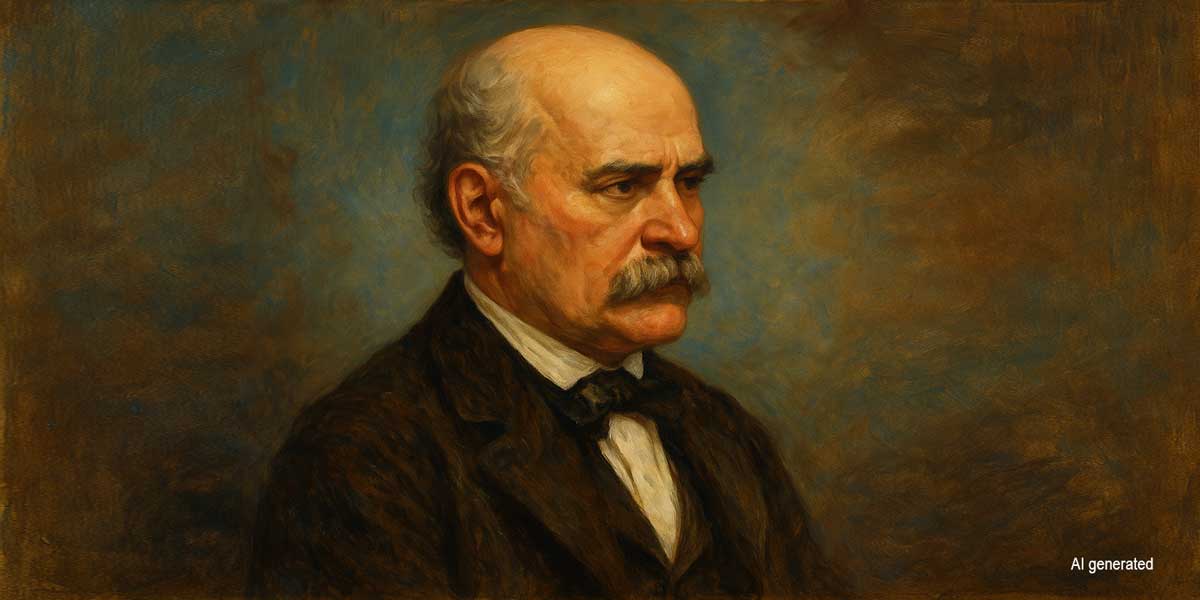
The Hungarian physician Ignaz Semmelweis, remembered as the “savior of mothers,” forever transformed the history of medical practice and hygiene in the mid-19th century. His name became a lasting symbol of the struggle to protect the lives of mothers and newborns. At a time when childbed fever was taking thousands of lives, he stood out as the first to demonstrate that the true cause lay in the unhygienic practices of physicians themselves. He proved that these tragic and often fatal outcomes could be prevented through a measure that seemed deceptively simple yet revolutionary for its time. The consistent washing of hands.
Tragedy in Vienna
At the First Obstetrics Clinic of the Vienna General Hospital, Ignaz Semmelweis began his work as an assistant on July 1, 1846. The clinic operated in two shifts that alternated continuously around the clock. One shift led by physicians and the other by midwives. The contrast between them soon revealed itself in devastating ways.
Mortality among mothers and newborns was dramatically unequal, for far more deaths occurred during the physicians’ shift, and the Encyclopaedia Britannica records that the death rate of mothers under their care reached as high as 25–30 per cent. That meant that nearly one in three women did not survive childbirth when doctors were in charge.
By contrast, mortality in the midwives’ shift remained significantly lower. This stark difference forced desperate women to wait outside the hospital gates during the physicians’ shift, hoping to endure until the midwives came on duty, since they knew their chances of survival were far greater once they entered under the care of the midwives.
How Ignaz Semmelweis Made His Discovery
The turning point came in May 1847. His friend Professor Kolletschke died from an infection after a wound during an autopsy.
Semmelweis realized that doctors carried “decay particles” from the morgue to the maternity ward. In June 1847, he introduced mandatory handwashing with a solution of chlorinated lime.
The results were dramatic. Mortality fell below 2%.
Ignaz Semmelweis Presents His Discoveries
Semmelweis’s observations began to spread through the works and lectures of his colleagues. On May 15, 1850, he personally presented his findings before the Vienna Medical Society (Gesellschaft der Ärzte in Wien) in an oral lecture.
Despite solid proof, many colleagues refused to accept that their own practices were killing patients.
Florence Nightingale, about whom we wrote earlier, also took pioneering steps in medical hygiene, ventilation, and the collection and use of statistical data.
See also: Clean Air Heals: Florence Nightingale
Resistance and Tragic End
The resistance to his discoveries was fierce. Many physicians perceived his conclusions as direct personal accusation.
In 1861, he published his book “The Aetiology, Concept, and Prophylaxis of Childbed Fever”. Yet despite the undeniable data, his work was met with ridicule and outright rejection.
In the summer of 1865, colleagues lured him under the pretext of a medical examination to a Viennese asylum for the mentally ill. Although some accounts suggest that fellow doctors themselves assaulted him before sending him there, official records tell a slightly different story.
According to the official version, guards in the asylum beat him, and the injury he sustained on his hand became infected. Two weeks later, on August 13, 1865, Ignaz Semmelweis died of sepsis. Tragically, the very disease he had fought against his entire life.
Lesson from the Past
Even Hippocrates had observed the link between disease and the air we breathe:
“Some diseases come from the way we live; others from the very air we inhale.”
In the 19th century, unwashed hands claimed countless lives, and the neglect of basic hygiene repeatedly turned into widespread tragedy.
Much later, in 1978, the death of Janet Parker, the last officially recognised victim of smallpox, infected by a virus that spread through a ventilation system, offered yet another grim warning.
See also: Janet Parker: Victim of a Deadly Virus from Ventilation
The story did not end with Semmelweis or with Janet Parker.
More recently, the world faced the COVID-19 pandemic, when the virus spread through the air and claimed millions of lives.
But was it inevitable? Could history lessons have prepared us better?
We should have already learned that air can be deadly, but it can also be life-saving.
What About Today?
History has a way of repeating itself.
Even today, mistakes still occur, and many people continue to resist the simple truth that air is the foundation of life, health, and success.
Marquis Intelligence has faced situations that echo the lessons of the past. A few years ago, the company received specifications for designing an additional air purification solution for a general hospital. The technical team at Marquis Intelligence approached the task with its trademark professionalism and precision, immediately noticing that both the neonatal ward and the morgue were connected to the same ventilation system, sharing the same air-handling unit.
The team instantly recalled the example of Ignaz Semmelweis and flagged this configuration as unacceptable. The project designer carefully reviewed the detailed expertise and reasoning provided by Marquis Intelligence and accepted it without objection. In doing so, a potentially tragic outcome was prevented.
Marquis Intelligence – Case from Practice
Today, we understand the critical importance of air quality for human health, including reproductive health and the success of in vitro fertilization. Over the decades, Marquis Intelligence has improved air quality in dozens of healthcare institutions across the region. Among them, one stands out for its importance even though it is not large in size – the private Special Gynaecology Hospital Ferona in Novi Sad.
This institution pays special attention to hygiene in every sense, and air hygiene is no exception. Although the clinic had already implemented the highest levels of filtration with HEPA filters in its ventilation systems, its leadership decided to bring in Marquis Intelligence for additional improvements. The reason was apparent: this hospital has built a reputation for successfully carrying out in vitro fertilisation procedures, and in that process, every single egg cell is precious.
We have already written about the importance of air quality for in vitro fertilization.
See also: The Stunning Impact of Air Pollution on In Vitro Fertilization Success
With a turnkey approach, Marquis Intelligence installed an advanced air treatment system using dielectric barrier discharge technology. The system included an automatic control loop to monitor air quality and adjust operations in real time. As a result, all odors from volatile organic compounds in outside air were eliminated.
Thanks to this approach and a comprehensive focus on hygiene, including air hygiene, the Ferona Specialized Gynecology Hospital strengthened its reputation and was recognized as the best private hospital in Serbia in the field of in vitro fertilization for 2024/2025. This award proves that outstanding results in reproductive health are impossible without carefully controlled air quality.
Cultural Heritage
Ignaz Semmelweis is remembered in culture as well. His statue stands in front of the Medical University in Budapest, and his bust is displayed at the Medical Faculty in Vienna. His life and work have been featured in documentaries, while educational series and animations portray him as a pioneer of hygiene and the doctor who saved countless lives.
History, Present, and Future
Ignaz Semmelweis showed how one pioneer can change the course of medicine. More than 160 years later, the lesson remains clear. Hygiene and air quality are essential for health.
Marquis Intelligence connects these historical lessons with modern expertise. The company is a pioneer in solving ventilation and air purification challenges in the region. Through its 4D Matrix, it provides tailor-made solutions and proves performance parameters in hospitals, clinics, and sterile zones. Today, Marquis Intelligence is a recognized brand for expert solutions that ensure safety, health, and sustainability.
Sources:
Encyclopaedia Britannica: Ignaz Semmelweis
Wikipedia: Ignaz Semmelweis
The British Journal of Psychiatry (Cambridge): Epidemics: wash your hands! The asylum delivery and violent death of Ignaz Semmelweis
Cambridge Univ. Press: Semmelweis and his predecessors
Semmelweis University Library: Years in Vienna
Dr Alanna Collen: 10% Human
This text is part of the “Learn More About Air Through History and People” series from the Marquis Intelligence archive.
Document: MI-LAH-007.25 – Ignaz Semmelweis: Saviour of Mothers and Newborns
