

Blog
Exhaust Hood Above a Dishwasher in a Commercial Kitchen

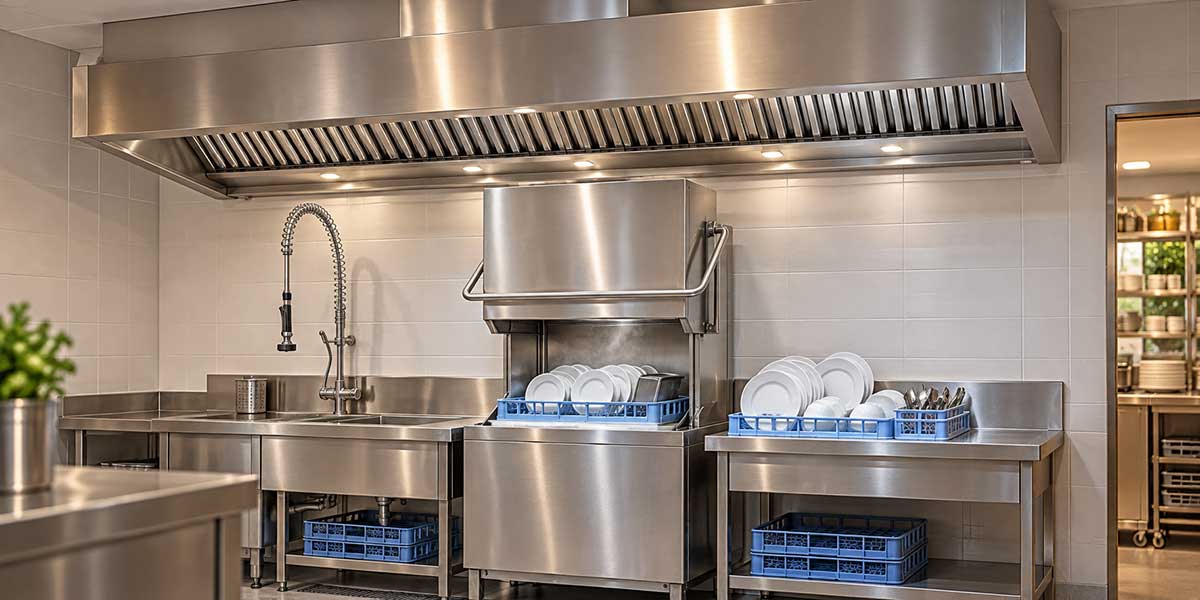
An exhaust hood above a dishwasher in a commercial kitchen should capture the steam released during operation. Its position must also allow the dishwasher to open fully and staff to handle dishes without obstruction. Selecting the right hood becomes particularly challenging when new equipment must be integrated into an existing kitchen and ventilation system.
A high faucet, suspended ceiling, or the position of an existing duct can determine the final solution. A detail overlooked on a drawing can become an everyday operational problem in the kitchen.
What Needs to Be Extracted from the Dishwashing Area?
When we think of commercial kitchen ventilation, we usually think of extraction above cookers, grills, and fryers. However, the dishwashing area also generates heat, moisture, and airborne pollutants.
The hood and its exhaust system remove warm, humid air, odors, and fine droplets dispersed in the air-liquid aerosols. Depending on the chemicals used and the operating process, these droplets may also contain components of detergents, rinse aids, or disinfectants.
The aim is to limit the spread of these emissions into the working area. This includes the visible cloud of fine droplets released when the dishwasher opens, commonly referred to as “steam”.
If the system does not remove enough moisture, water vapor can condense on cooler surfaces such as ceilings, walls, and equipment. Prolonged surface moisture can promote mold growth and make it more difficult to maintain good hygiene.
Does Every Dishwasher Need an Exhaust Hood?
No. Some professional dishwashers have integrated steam condensation or heat recovery systems. For certain models, the manufacturer allows operation without a separate external hood under clearly defined conditions.
The decision therefore depends on the specific dishwasher, its technical documentation, and the requirements of the building. The ventilation and air-conditioning calculations must still account for any remaining heat and moisture loads.
What Type of Hood Is Used Above a Dishwasher?
The ASHRAE Handbook – HVAC Applications, in its chapter “Kitchen Ventilation”, distinguishes between two types of hoods:
- Type I – for emissions containing grease and smoke;
- Type II – for removing heat and moisture without these emissions.
Under this classification, an exhaust hood above a professional dishwasher is a Type II hood when its purpose is to remove heat and moisture without capturing grease and smoke generated by cooking processes.
This classification is useful when working on international projects and reviewing foreign technical documentation. For each individual project, however, designers must also check the applicable national regulations and standards.
Is Hood Selection Based Only on the Dishwasher Dimensions?
The width and depth of the closed dishwasher are not enough to determine the correct hood.
The way the dishwasher opens also matters. So do the arrangement of surrounding equipment and the workflow throughout the dishwashing area.
The hood dimensions and position must allow it to capture emissions effectively. At the same time, staff must be able to work without obstruction and have adequate access for maintenance.
Why Does the Way the Dishwasher Opens Matter?
For professional hood-type dishwashers, designers must check the total height of the unit when fully open. This includes the lifting mechanism and handles. The exhaust hood must be positioned high enough to allow the dishwasher to open completely.
For front-loading dishwashers, the position of the open door and the area required to pull out the dish rack must be considered. In both cases, the exhaust hood should cover the area where steam is released.
The installation height and hood overhangs depend on the dishwasher’s technical parameters and operating method, the manufacturer’s documentation, and local airflow conditions.
High Faucet and Pre-Rinse Spray
A pre-rinse sink is often installed next to the dishwasher. It typically has a high faucet, flexible hose, and pre-rinse spray. This assembly may be higher than the closed dishwasher and can therefore determine the hood installation height.
The height of the faucet is not the only consideration. Designers must also account for the movement of the hose and the space required for handling it. If the hood also covers the pre-rinse area, its footprint should extend over the relevant working area above the sink.
Raising the hood to provide enough space for the faucet increases the distance between the hood and the source of emissions. Designers must therefore reassess steam capture and the required exhaust airflow.
Metal Filters or Droplet Eliminators?
Metal elements installed in a hood above a dishwashing area may look like grease filters. However, their appearance alone does not reliably indicate their function.
Droplet eliminators, or droplet separators, remove water droplets from the exhaust air. In designs with profiled blades, the air changes direction several times. Inertia causes the droplets to separate from the airflow and collect on the metal surfaces. They then merge and drain towards the collection point.
Grease filters, on the other hand, are designed to separate grease aerosols. The correct element must therefore be selected according to its intended function, airflow rate, and declared separation performance.
Mechanical droplet separation does not remove gaseous substances that cause odors. Nor does it remove water vapor itself. Water vapor may remain in the air and later condense on cooler surfaces within the system.
Where Does the Condensate Go?
In some hood designs, the internal surfaces and baffles promote water vapor condensation and collect the resulting water.
It is important to distinguish between condensation and droplet separation.
Condensation is the process by which water vapor changes into liquid water. Droplet eliminators mechanically separate droplets that are already present in the air.
The hood’s internal surfaces should direct water towards a collection channel or tray with suitable drainage or emptying provisions. Condensate must not drip uncontrollably onto clean dishes, work surfaces, or employees.
Condensate can also drain from the ventilation duct through the hood’s exhaust connection. Depending on the system design, an additional baffle may be required to collect this condensate and direct it towards the drain.
The duct system design should also consider the risk of condensation, the need for insulation, appropriate duct slopes, and suitable water collection points.
Are All Hoods Made from the Same “Stainless Steel”?
The term “stainless steel” alone is not a sufficient material specification for a kitchen hood.
The choice between AISI 304 and AISI 316 stainless steel depends on several factors: water composition; chemicals used; temperature; exposure to condensate; maintenance procedures.
AISI 304 may be suitable for the expected operating conditions. A more corrosive environment, however, may justify the use of AISI 316. The term “acid-resistant steel” does not mean that the material is resistant to every chemical or every concentration.
Surface finish and joint quality are equally important. The design should also avoid areas where water and contaminants can accumulate.
Position and Dimensions of the Exhaust Connection
The position of the exhaust connection must match the hood geometry, exhaust airflow distribution, and duct route. Larger hoods may require more than one exhaust connection. In that case, the airflow must be properly balanced.
The required airflow rate and selected air velocity determine the cross-sectional area of the connection. Designers must also check pressure drop and noise levels.Gradual transitions and elbows with larger bend radii reduce local airflow resistance.
Lighting and Maintenance Should Be Planned in Advance
The hood may block ceiling lighting. Good visibility must therefore be provided in the dishwashing and dish inspection areas. Built-in lights and electrical connections must have an appropriate IP protection rating. The required rating depends on exposure to moisture and splashing, as well as the cleaning method.
Droplet eliminators and other washable components should be easy to remove and reinstall. The inside of the hood, collection channel, condensate drain, and lights must remain accessible for cleaning and maintenance.
Is the Hood Alone Enough to Remove Steam and Vapors?
No. Removing heat, vapors, and odors requires a complete and functional system: an exhaust hood;an appropriate exhaust connection; ductwork; a fan; a properly selected discharge location.
A hood without an integrated fan can be connected to a separate exhaust system. The fan may be installed in the duct or elsewhere in the system. The absence of a fan inside the hood does not mean that the exhaust system operates without one.
The need for additional exhaust air purification depends on the composition of the exhaust air, the discharge location, and its impact on the surrounding environment.
SEE ALSO: Commercial Kitchen Exhaust Ventilation: From Fire Risk to Safe Operation
SEE ALSO: Mini Case Study: Commercial Kitchen Ventilation Under Space Constraints in the City Centre
A More Powerful Fan Is Not Always the Solution
The required airflow rate and the total system resistance determine the correct fan selection. Supply and exhaust airflow must be balanced to maintain the designed pressure differences between zones.
Increasing the airflow does not necessarily improve steam capture. If the hood position or dimensions are inadequate, higher airflow alone will not solve the problem. The same applies if the supply air pushes steam away from the hood’s capture zone.
System performance should be verified by measuring airflow and observing steam capture.
This is particularly important when opening a hot dishwasher while the surrounding equipment is operating.
Applicable Standards
The EN 16282 series provides a relevant framework for commercial kitchen ventilation. Part 1 covers general requirements and airflow calculations. Part 2 covers the design and requirements for kitchen ventilation hoods, including safety and hygiene characteristics.
Designers should always check the current editions of the standards and the requirements applicable to the specific project.
- Institute for Standardization of Serbia – SRPS EN 16282-1:2017 and its revision project
- Institute for Standardization of Serbia – SRPS EN 16282-2:2017
A Practical Example from Marquis Intelligence
For the canteen of an IT company in the Green Heart business complex in New Belgrade, Marquis Intelligence designed, supplied, and installed an exhaust hood above a new, larger dishwasher.
Replacing the existing dishwasher required a new exhaust ventilation calculation and a new hood design. The assessment showed that the existing exhaust duct and fan could meet the requirements of the new dishwasher. However, the existing hood had to be replaced.
The suspended ceiling limited the available installation space. At the same time, the offset centreline of the new dishwasher made it more difficult to connect the hood to the existing exhaust duct. During installation, the team used hydraulic cylinders to lift and level the hood.
Protecting the interior finishes and existing equipment from dirt and damage during the work presented an additional challenge.
SEE ALSO: FAQ – Exhaust and Purification of Waste Air from Kitchen Hoods
Marquis Intelligence designs, installs, and maintains commercial kitchen ventilation systems, including exhaust ventilation and exhaust air purification.
The company also designs and installs kitchen hoods adapted to the equipment, work processes, and spatial constraints of each project. This includes exhaust hoods above professional dishwashers.
Investors and operators planning a new commercial kitchen, renovating an existing one, or replacing a dishwasher can contact the Marquis Intelligence technical team. Our team can design and implement a solution tailored to the equipment and the specific conditions of the space.
This article is part of the Marquis Intelligence professional series “Commercial Kitchen Ventilation and Exhaust Air Purification”. The series addresses technical challenges in professional kitchen ventilation, with a particular focus on exhaust ventilation and exhaust air treatment under real operating conditions.
Document: MI-KV-002.26 – Exhaust Hood Above a Dishwasher in a Commercial Kitchen
