

Blog
Mini Case Study: Commercial Kitchen Ventilation Under Constrained Conditions in the City Centre

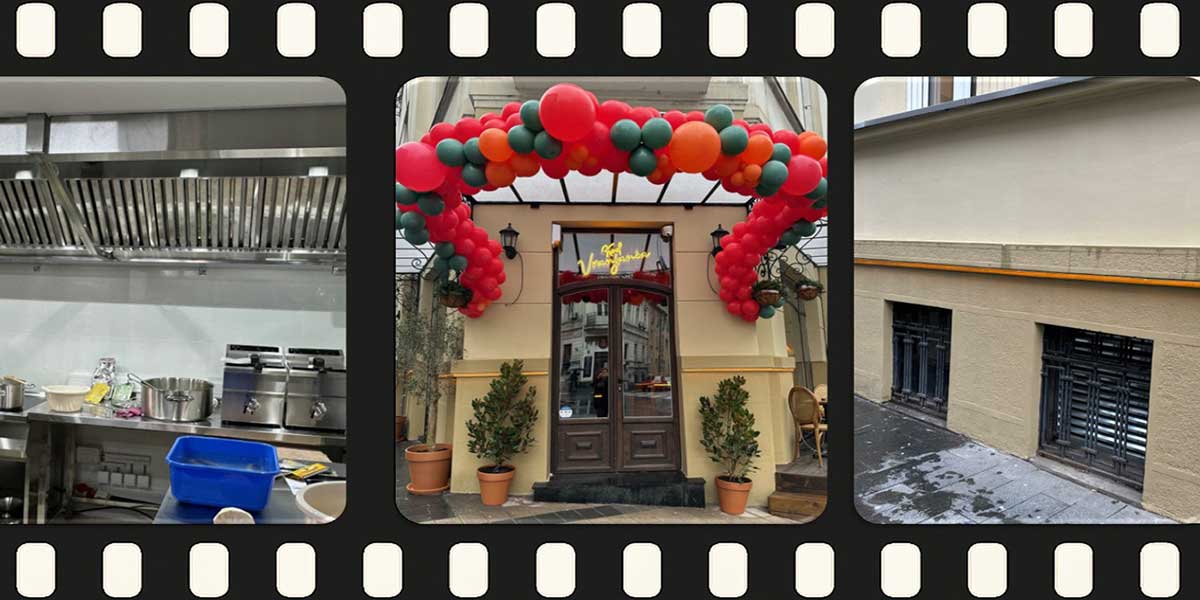
Commercial kitchen ventilation became a key challenge in a building that houses the headquarters of Marquis Intelligence, located in the very centre of Belgrade.
A commercial space on the ground floor became available for lease. An attractive location. A representative building. Ceiling height of approximately 5 meters – almost ideal for a hospitality venue.
The space was soon converted into a restaurant.
However, behind this seemingly simple idea, a critical technical issue emerged: commercial kitchen ventilation. In this building, already constrained by significant technical and spatial limitations, further complicated by its status as a protected cultural heritage property, ventilation proved particularly challenging.
Initial Client Requirements
From the very beginning, it was clear that standard solutions would not be applicable.
It was not possible to route exhaust air to the highest point of the building, which is the conventional approach in commercial kitchen ventilation design.
At the same time, uncontrolled discharge of air containing grease and odours was not an option. The building façade is protected by the state, and directly above the restaurant is the office space of a company specialising in air quality.
The kitchen itself presented additional constraints. It was located in a semi-basement, with windows at sidewalk level. Less than 1.5 meters above them were the windows of the ground-floor space.
The client’s initial request was clear: a unit for exhaust air extraction and purification – primarily to eliminate unpleasant odours.
According to the initial plan, the ventilation system was to be installed by a standard contractor.
Challenges Escalate
The problem quickly evolved beyond simple odour removal into controlled air management under real conditions.
Although initially engaged as an equipment supplier, the Marquis Intelligence team, consistent with its professional standards and responsibility toward the surrounding environment, became involved in analysing the entire system.
It soon became clear that the problem could not be addressed in isolation.
In addition to odour elimination, it was necessary to ensure proper air capture and direction above cooking appliances. This required a custom-designed kitchen hood, adapted to the spatial limitations.
Under these conditions, a wall-mounted inclined hood with rear connections was developed, instead of the standard top connection.
SEE ALSO: FAQ – Kitchen Exhaust Air Extraction and Purification
The originally selected contractor withdrew from the project due to these non-standard requirements. Marquis Intelligence then took over this part of the project as well.
Unexpected On-Site Challenges
During implementation, additional issues arose that were not directly related to ventilation but had a significant impact on the project.
During the preparation phase, concerns emerged regarding the feasibility of transporting equipment into the basement kitchen. Detailed measurements by the Marquis Intelligence team revealed that structural columns and thick load-bearing walls – over 50 cm thick – prevented the installation of large equipment. Additionally, the existing opening between the kitchen and the restaurant area was insufficient in size.
At that point, the installation of restaurant equipment had already begun, and the placement of a display counter directly in front of the opening was planned.
A decision was made to adapt the project to actual on-site conditions. The installation of the display counter was cancelled. The existing opening was enlarged before tiling works began. This intervention enabled not only the installation of the ventilation system but also the smooth installation of the complete kitchen equipment – avoiding serious issues in later project stages.
Technical Solutions
Taking into account all identified challenges, the system was designed as an integrated whole.
Special attention was given to ventilation ducts, where welded joints were applied to ensure high airtightness and fire safety.
Additional issues addressed included:
- controlled air discharge
- outlet positioning near a pedestrian zone
- noise reduction through silencers
The air outlet was carefully positioned to ensure controlled airflow velocity and direction.
Acoustics
Particular attention was also paid to the system’s acoustic performance.
Even though the air extraction and purification unit is located within the kitchen itself and even integrates an additional working surface, its operation is almost silent.
At the external weather louvre, there is no noticeable airflow or odour, confirming both system efficiency and control of discharge parameters.
Air Discharge Grille
An additional challenge arose in defining the discharge grille.
Since its lower part is positioned at sidewalk level, it was necessary to consider the possibility of snow accumulation during winter.
The lower section of the grille was therefore closed, preventing the ingress of precipitation and ensuring reliable operation in all weather conditions.
Maximizing Space Utilization
One of the key requirements was fitting the entire system into a limited space.
The air extraction and purification unit was positioned at floor level, while its upper surface was used as an additional work area.
This solution enabled full functional integration of the system into the workspace, without loss of usable area.
Daylight
Positioning the unit at floor level and integrating a work surface also improved the use of available space, allowing better penetration of natural daylight into the kitchen.
Final Solution
The originally selected contractor completely withdrew from executing the standard scope of work. As a result, the complete commercial kitchen ventilation system was ultimately realised by Marquis Intelligence. The exhaust ventilation system for this kitchen was adapted to all specific technical and spatial constraints of the project.
The implemented system included:
- a kitchen hood designed according to real operating conditions
This enabled more efficient capture of steam, grease, and odours generated during kitchen operation. - a multi-stage exhaust air treatment system
This significantly reduced unpleasant odours and air pollution before discharge into the outdoor environment. - a sound attenuator
This ensured quieter system operation and reduced impact on the surrounding area. - controlled exhaust air discharge
This provided a more stable and safer direction of exhaust airflow. - a carefully positioned discharge outlet in a pedestrian zone
This minimised the system’s impact on the everyday use of the surrounding space. - welded high-sealing ventilation ducts
This increased system safety and ensured more reliable long-term operation.
Results
The results are immediately visible in the daily operation of the facility:
- elimination of unpleasant odours
- stable and reliable system performance
- controlled discharge with no impact on the surroundings
- low noise levels
- safe operation in proximity to occupants
More Than Ventilation
This project demonstrates that commercial kitchen ventilation does not depend on a single system component, but on a holistic engineering approach.
SEE ALSO: Mini Case Study: Kitchen Exhaust Air Purification at Mövenpick Hotel Teuta Kotor Bay
In projects of this type, technical solutions do not begin with equipment, but with understanding real spatial constraints and user requirements. Continuous on-site presence and involvement in the broader project context transformed the role of the supplier into that of an engineering partner.
Marquis Intelligence has previously written about the technical aspects and risks of commercial kitchen exhaust systems.
SEE ALSO: Commercial Kitchen Exhaust Ventilation – From Fire Risk to Safe Operation
Recommendations as Proof of Client Satisfaction
The success of this system did not remain only at a technical level. Shortly after commissioning, new inquiries began to arrive – directly as a result of recommendations from this restaurant.
However, perhaps the most important aspect of this project is its verifiability.
This project requires no presentation.
It is enough to experience it – and to hear the recommendation.
This text is part of the “Mini Case Studies” series by Marquis Intelligence.
Document ID: MI-MCS-07.2Q-26
Title: Mini Case Study: Commercial Kitchen Ventilation Under Constrained Conditions in the City Centre
