

Blog
Commercial Kitchen Exhaust Ventilation: From Fire Risk to Safe Operation

Commercial Kitchen Exhaust Ventilation: From Fire Risk to Safe Operation
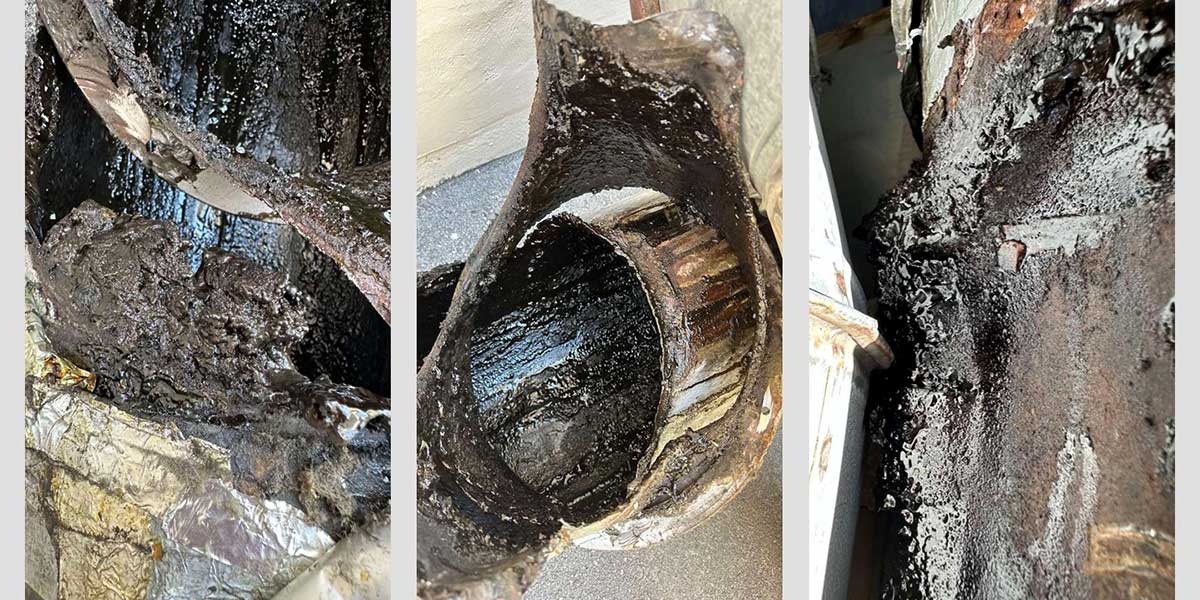
A little over a year ago, a restaurant that had been successfully operating for years on the ground floor of the Marquis Intelligence office building closed its doors. During the relocation, the commercial kitchen exhaust ventilation system, from the hood to the discharge point at the highest part of the building, was dismantled.
The dismantled ventilation ducts, seen in front of the Marquis Intelligence building, looked alarming. Their inner surfaces were covered with thick layers of black, greasy deposits.
This clearly demonstrates how an inadequately designed and maintained commercial kitchen exhaust system can pose a serious risk to the entire building.
What Is Commercial Kitchen Exhaust Ventilation?
Commercial kitchen exhaust ventilation is a system designed to remove fumes, grease, odors, and heat from the kitchen and discharge them outdoors.
It typically consists of a kitchen hood with filters, ventilation ducts, and a fan. But it should also include air purification systems.
In this particular kitchen, that last component was missing.
SEE ALSO: FAQ – Kitchen Ventilation
Air in Commercial Kitchens
During daily operation, commercial kitchens generate a complex mixture of pollutants.
Frying and grilling can produce up to 200 chemical compounds, primarily due to the breakdown of fats at high temperatures. These substances occur as aerosols, particles, and gases, including aldehydes and other compounds with significant toxic and carcinogenic potential.
At the same time, exhaust air contains grease, smoke, odors, and water vapor.
What is the Role of a kitchen hood?
The kitchen hood is the first element of the exhaust ventilation system. Its function is to capture polluted air generated during food preparation.
Typically, kitchen hoods include metal filters for coarse air filtration.
From the hood, air is transported through ventilation ducts by a fan and discharged into the atmosphere.
Is It Necessary to Purify Exhaust Air?
If the air from the kitchen hood is not properly treated, several problems arise:
- accumulation of contaminants inside ducts and equipment
- spreading of unpleasant odors around the discharge location
- increased fire risk
- reduced efficiency of the exhaust system
- increased noise due to contaminated fans and reduced duct cross-sections
SEE ALSO: Mini Case Study: Kitchen Exhaust Air Purification at Mövenpick Hotel Teuta Kotor Bay
Are Grease Exhaust Ducts a Fire Hazard?
Yes. Ventilation ducts where grease accumulates represent a significant fire risk.
Grease deposits are highly flammable. In case of fire, they allow rapid fire spread through the ventilation duct system.
In dense urban areas, such as central Belgrade, this risk is not limited to the kitchen – it can endanger the entire building and neighbouring structures.
This is why the Marquis Intelligence team was concerned when they saw the dismantled ducts covered with thick, highly flammable deposits – especially since maintenance crews had regularly been seen servicing the system.
Reducing Fire Risk Through Proper Ventilation Design
If a commercial kitchen exhaust system is properly designed and installed, includes air purification, and is regularly maintained, the risk can be reduced to a minimum.
Why Exhaust Alone Is Not Enough
A common misconception is that a kitchen hood and basic exhaust system are sufficient.
However, without proper air treatment, the problem is not solved – it is simply relocated.
Untreated exhaust air can:
- spread unpleasant odors
- cause grease buildup on facades and ducts
- lead to complaints and operational issues
- increase fire risk
The goal of a properly designed system is not just to remove air, but to control and treat it before discharge.
Engineering Approach: From Problem to Solution
Effective solutions in professional kitchen ventilation are based on analysing specific conditions:
- type of kitchen
- cooking processes
- operating режим
- spatial constraints
- urban context
In practice, Marquis Intelligence does not apply a universal solution. Instead, it designs multi-stage air treatment systems tailored to real operating conditions.
This approach proved essential in a restaurant ventilation project in the very centre of Belgrade, implemented in a building with significant technical and spatial limitations.
SEE ALSO: Mini Case Study: Commercial Kitchen Ventilation Under Constrained Conditions in the City Center
The goal is to achieve defined, measurable air quality parameters, adapted to the specific building and environment, while ensuring quiet system operation.
Maintenance as a Key to Reliability
Even the best-designed and installed system will not perform properly without maintenance.
Kitchen exhaust air naturally carries grease and particles that accumulate on filters and inside ducts. Without regular maintenance, system efficiency decreases, and risks increase.
That is why maintenance is an integral part of the system—not an optional add-on.
SEE ALSO: HVAC and IAQ System Maintenance – The Pillar of Reliability
A Different Outcome: A New Restaurant in the Same Building
After the previous restaurant in the Marquis Intelligence building in central Belgrade closed, a new restaurant opened.
This time, the approach was different.
The commercial kitchen exhaust ventilation system was designed and implemented by the Marquis Intelligence team, with a focus on:
- reliable system operation
- controlled purification of exhaust air
- long-term safety
- quiet performance
- compact equipment dimensions
When a project is implemented in a building that also houses the company’s headquarters, there is no room for compromise in standards.
Commercial Kitchen Ventilation and Safety
The difference between a potential fire hazard and a safe, reliable system is not accidental.
It is the result of:
- proper engineering approach
- appropriate technology selection
- high-quality installation
- and regular maintenance
Commercial kitchen exhaust ventilation is not just a matter of comfort.
It is a matter of safety – for users, the building, and the surrounding environment.
Exhaust air from commercial kitchens is not only a technical and safety issue – its impact on the health of employees and building occupants is also significant.
Sources
- Recknagel, Sprenger, Schramek – Taschenbuch für Heizung und Klimatechnik
- Environmental Science: Processes & Impacts – Air pollution in commercial kitchens (DOI: 10.1039/D2EM00484D)
- Environmental Health Perspectives – Gas stove emissions and indoor air pollution (DOI: 10.1289/EHP14180)
This article is part of the Marquis Intelligence expert series “Commercial Kitchen Ventilation and Exhaust Air Treatment”, addressing technical challenges in professional kitchen ventilation, with a particular focus on extraction systems and exhaust air treatment under real operating conditions.
Document: MI-KV-001.26 – Commercial Kitchen Exhaust Ventilation: From Fire Risk to Safe Operation
