

Blog
CO₂ in Your Home – Is It There and Where Does It Actually Come From

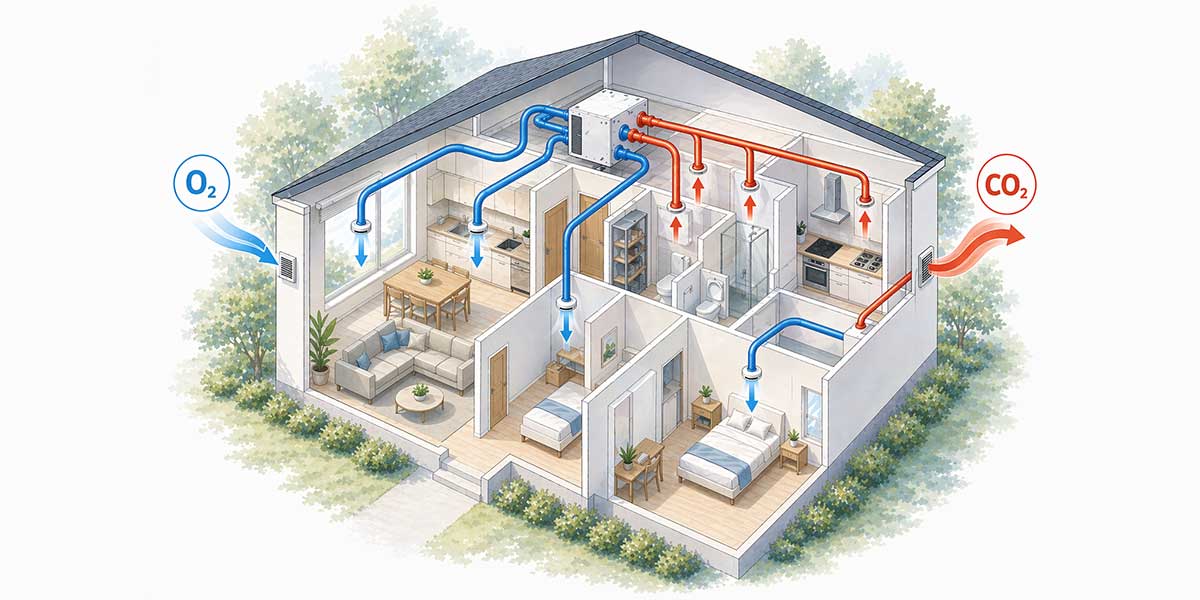
CO₂ in your home is present even when you do not notice it or recognize the symptoms of elevated levels. You may feel unexplained fatigue, reduced concentration, or a sense that the air is “not fresh”. Therefore, understanding CO₂ is the first step towards understanding home ventilation.
Indoor air appears the same as outdoor air—invisible, silent, and taken for granted. However, the moment we enter a space and begin to occupy it, its composition starts to change.
How Much CO₂ Is in Outdoor vs Indoor Air?
Outdoor CO₂ concentrations typically range between 350 and 450 ppm. For indoor environments, 600–800 ppm indicates good air quality. Around 1,000 ppm is considered the upper acceptable limit (the Pettenkofer number). Higher concentrations indicate declining air quality:
- 1,000–2,000 ppm → poor air quality, reduced comfort, and cognitive performance
- Above 2,000 ppm → unacceptable air quality (commonly reached in unventilated bedrooms)
- Around 5,000 ppm → maximum allowed for an 8-hour work environment
- Above 5,000 ppm → more serious physiological effects may occur
- 6,000–30,000 ppm → only short-term exposure allowed
- At concentrations higher than 3% (30,000 ppm), there is rapid breathing, headaches, and disturbances in body functions
Extremely high concentrations (above 10%) may lead to loss of consciousness and represent a serious health risk.
(Source: REHVA Journal – CO₂ monitoring and indoor air quality; EN 16798-1:2019; ASHRAE Position Document on Indoor Carbon Dioxide, 2025)
CO₂ in Your Home – Where Does It Come From?
CO₂ in your home is primarily generated within the space itself. The main source is people. Through respiration, each person continuously emits CO₂.
On average, a person emits about 0.7 kg of CO₂ per day. Since we spend approximately 65% of our lives at home, this amounts to about 455 grams of CO₂ per person per day indoors. As a result, in enclosed, unventilated spaces, CO₂ concentration increases in proportion to the number of occupants and the duration of their stay.
In addition to breathing, CO₂ is produced by burning in fireplaces, using gas stoves and other devices with open flames, lighting candles, cooking, and smoking.
Plants are often seen as beneficial; however, at night, when photosynthesis stops, they also emit CO₂. While their impact is smaller than that of humans, in enclosed spaces without adequate ventilation they still contribute to the overall CO₂ concentration.
Where Does CO₂ Accumulate the Most?
CO₂ does not distribute evenly. Instead, it depends on room usage. Bedrooms typically show the highest levels. Long occupancy and closed windows at night often push CO₂ above 2,000 ppm. As a result, people wake up tired, yawning, and unable to fully recover.
Elevated CO₂ levels also occur in living rooms (due to gatherings) and kitchens (due to occupancy + combustion).
The pattern is always the same: more people, longer stay, and insufficient ventilation.
Can Air Purifiers Reduce CO₂ in Your Home?
No. Air purifiers effectively remove particles, pollen, dust, and microorganisms. However, CO₂ is a gas produced by breathing, and standard filters, including HEPA, cannot remove it.
Therefore, local air purifiers are not a solution for CO₂ reduction.
ASHRAE also highlights that CO₂ is not a universal indicator of air quality, but it clearly states that CO₂ cannot be reduced without ventilation.
Can Plants Solve the CO₂ Problem in Your Home?
No. Plants cannot solve CO₂ accumulation – especially at night when they emit CO₂ themselves.
Nevertheless, indoor plants contribute to a sense of cosiness. Their effect is not only aesthetic or psychological. Through biological and chemical processes, plants can influence the microclimate and overall indoor environmental quality (IEQ).
However, it is essential to understand their limitations:
Plants can contribute to comfort and certain aspects of air quality, but they cannot replace ventilation or solve CO₂ accumulation in a space.
How Is CO₂ Actually Reduced?
The only effective way to reduce CO₂ in your home is through ventilation – bringing in fresh air and removing stale, CO₂-rich air.
Ventilation can be:
- natural (opening windows)
- mechanical (centralised or decentralised ventilation systems)
At first glance, natural ventilation seems simple. However, it requires real airflow, which means fully opening windows, creating cross-ventilation, and repeating this regularly.
In practice, this means opening multiple windows at least once per hour – which is rarely done, especially in winter or poor weather.
In modern airtight buildings, where infiltration is minimal, natural ventilation is often not sufficient to ensure stable air quality.
Therefore, mechanical ventilation systems are increasingly used to provide continuous, controlled air exchange, independent of outdoor conditions.
SEE ALSO: Residential ventilation by Marquis Intelligence
SEE ALSO: Decentralized Ventilation Systems in the Home: Advantages and Limitations
SEE ALSO: Mini Case Study: Verifying the Performance of a Central Ventilation System in an Apartment
The Marquis Intelligence Approach
Marquis Intelligence treats air quality as a system-level issue.
CO₂ is not analysed in isolation but as part of the overall indoor environmental quality. The solution combines:
- controlled ventilation
- filtration and air purification
- energy recovery
This approach enables the provision of healthy air, energy efficiency, and stable living conditions simultaneously.
Without ventilation → CO₂ increases
Without filtration → outdoor pollution enters
That is why their integration is the only sustainable solution.
Real Example – Marquis Intelligence Solutions
In practice, the effect of air quality is most clearly seen where we inhale it for the longest time – during sleep. One of Marquis Intelligence’s clients, after installing a ventilation system in his apartment, described the change very simply. He said that, in a space with controlled ventilation, he now sleeps fewer hours but wakes up rested, “as if he were in the mountains”.
This is not an exception. It reflects a direct connection between air quality and sleep quality, especially in rooms where CO₂ rises the most.
You Might Be Wondering…
If CO₂ increases in homes, what happens in crowded spaces?
Classrooms, meeting rooms, and conference halls are typical examples where CO₂ levels rise rapidly.
Under such conditions, there is a drop in concentration, drowsiness, and reduced work efficiency.
Professional practice has long recognised that ventilation requirements depend on occupancy load. For example, spaces with smokers require significantly higher fresh air supply – and even more during active smoking.
This clearly shows how quickly indoor conditions change – and why ventilation must match real usage.
SEE ALSO: FAQ – Home Ventilation
Conclusion
CO₂ in your home is not an exception. It is constantly present and naturally generated through breathing. In other words, people are the primary source of CO₂ in indoor spaces.
The question is not whether it is there, but whether you control it.
CO₂ is not removed – it is diluted with fresh air.
In the following articles, we will address the specific consequences of elevated indoor CO₂ levels, particularly their impact on sleep quality and cognitive performance.
Ventilation is not an addition to a home – it is a fundamental requirement for healthy air.
Sources
- REHVA Journal (2021). CO₂ monitoring and indoor air quality
- ASHRAE (2025). Position Document on Indoor Carbon Dioxide
- EN 16798-1 (2019). Ventilation of buildings
- NOAA (2024). Atmospheric CO₂ trends
- EPA (2024). Carbon dioxide emissions
- Persily, A. (2015). Ventilation and indoor air quality
This Marquis Intelligence article is part of the series: “Home Ventilation”
Document: MI-HV-007.26 – CO₂ in your home – is it there and where does it actually come from?
