

Blog
9 Benefits of Bipolar Air Ionization in a Central Home Ventilation System

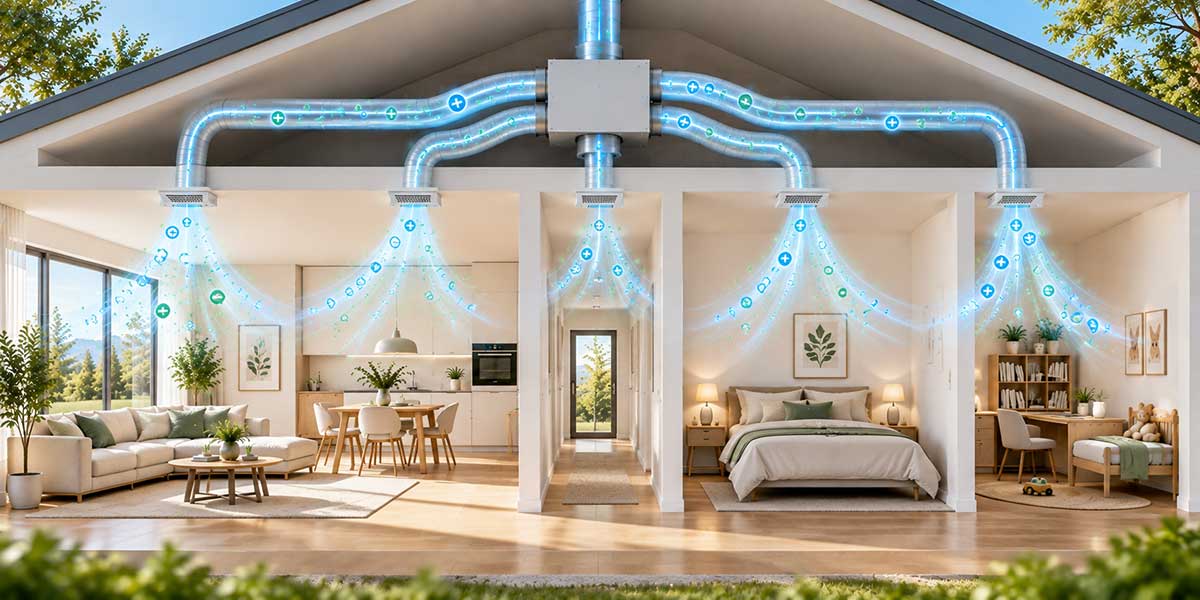
Bipolar air ionization in a central home ventilation system provides an additional, unconventional level of air treatment that can help improve indoor air quality in your home. Therefore, in this article, we highlight nine of the most important benefits of bipolar air ionization in central ventilation systems.
However, bipolar air ionization is a technology, not magic. Several prerequisites must be met to achieve effective air treatment.
Prerequisites for Effective Bipolar Air Ionization in a Central Ventilation System
Bipolar air ionization can provide many benefits as part of a central ventilation system, provided that:
- the bipolar ionization system is properly designed and coordinated with the central ventilation system;
- the bipolar ionization equipment, as well as the other components of the central ventilation system, is functional and of good quality;
- the systems are properly configured, operate together as intended, and receive appropriate maintenance.
When these prerequisites are met, bipolar air ionization becomes an integral part of the system for controlled air treatment and distribution throughout the home.
Benefits of Bipolar Air Ionization in a Central Home Ventilation System
What are the main benefits of bipolar air ionization when it forms part of a properly designed central ventilation system?
-
Provides Additional Treatment of Fresh Air After Filtration
Outdoor air today is generally not clean. According to the World Health Organization, 99% of the world’s population lives in areas where air pollution levels exceed WHO guideline limits.
It is therefore particularly important to clean outdoor air in a central ventilation system before introducing it into the home. As a rule, the air first passes through filters that remove particulate pollutants.
Bipolar air ionization provides an additional level of air treatment after filtration. Positive and negative ions are introduced into the already filtered airflow before the system distributes it throughout the home.
As a result, the rooms receive not only filtered outdoor air but also air that has undergone additional bipolar ionization treatment.
-
Acts on Both Outdoor Pollution and Pollution Generated Inside the Home
This is one of the particularly important benefits of bipolar air ionization in a central ventilation system.
Outdoor air is often polluted, but pollution sources also exist inside our homes. According to the U.S. Environmental Protection Agency (EPA), concentrations of some pollutants indoors are often two to five times higher than typical outdoor concentrations.
At the same time, we spend about 90% of our time indoors. The Healthy Buildings Program at the Harvard T.H. Chan School of Public Health states that we spend around 65% of our lives in our homes.
This makes one feature of bipolar air ionization in a central ventilation system particularly important: its effect is not limited to the outdoor air passing through the system.
Cooking, cleaning, people, pets, furniture, finishing materials, and products we use every day can generate particles, odors, volatile organic compounds, and microbiological contaminants.
The system distributes positive and negative ions throughout the rooms together with the treated air. They can therefore also act on pollutants generated inside the home.
-
Reduces the Number of the Smallest Airborne Particles
One important application of bipolar air ionization is the reduction of very small particles.
Ions charge airborne particles and can promote their agglomeration. This creates larger particle structures that can be removed from the air more easily.
This effect is particularly important for ultra-fine particles, which have a diameter of up to 0.1 µm. Because of their small size, these particles can penetrate deep into the lungs. Some may also enter the bloodstream. Exposure to ultra-fine particles is associated with an increased risk of respiratory and cardiovascular diseases.
SEE ALSO: 11 Questions and Answers: How Do PM2.5 Particles Affect Health?
-
Can Improve Particle Filtration Efficiency
Bipolar air ionization and filtration are not two completely separate processes. In a properly designed system, they can complement each other.
Charging particles and promoting their agglomeration changes the way they behave in the air. When these ionized particles subsequently pass through a filter, the filter may capture them more effectively.
The effect depends on the system configuration, the position of the ionizer, and air circulation. Any potential improvement in filtration efficiency must therefore be evaluated as part of the complete system, rather than as an isolated characteristic of the ionizer.
-
Helps Reduce Unpleasant Odors
Unpleasant odors in the home often result from emissions of various gaseous compounds. Cooking, cleaning, and other everyday activities can generate these compounds.
Bipolar air ionization can act on certain compounds responsible for unpleasant odors, and help reduce them.
Because the system distributes the ions together with the air, their effect is not limited to the location where the ionizer is installed.
-
Can Reduce Concentrations of Volatile Organic Compounds – VOCs
Volatile organic compounds (VOCs) can originate from emissions from furniture, building and finishing materials, cleaning products, cosmetics, and other products used indoors.
Bipolar air ionization can help reduce the concentrations of certain VOCs in the air.
The effect depends on the type of compound, the technology used, the ion concentration, the contact time, and indoor conditions. For this reason, test results for a specific device should always be considered in the context of the technology and the system in which it is used.
-
Helps Reduce Airborne Allergens
Airborne allergens can enter from outdoors, but many sources also exist inside the home. Pollen, mold spores, and allergens associated with dust mites and pets are just some examples.
Many allergens travel through the air as particles of different sizes. By charging these particles and promoting their agglomeration with other particles, bipolar air ionization can help remove them from the air more effectively.
In a central ventilation system, there is an additional benefit: the system treats both the air entering from outdoors and the air containing allergens released or resuspended inside the home.
-
Acts on Microbiological Contaminants
Bipolar air ionization can act on certain microorganisms present in the air and on surfaces that come into contact with treated air. The effect depends on the type of microorganism, the technology used, the ion concentration, and exposure time.
It is therefore important to use proven equipment with documented test results and to apply it correctly within the specific system.
-
Helps Maintain the Microbiological Hygiene of the Air Distribution System
This is another specific benefit of bipolar air ionization in a central ventilation system.
The ions travel with the air through the distribution network before reaching the rooms. The treated air therefore also comes into contact with the internal surfaces of ventilation ducts and other air distribution components.
In this way, bipolar air ionization can help maintain the microbiological hygiene of the air distribution system.
Does Bipolar Air Ionization Replace Filtration?
No. Bipolar air ionization and filtration perform different functions in air treatment.
A filter captures particles from the air that pass through it. Bipolar air ionization provides additional air treatment. The ions then continue to travel with the air through the distribution network and into the rooms.
This is precisely why bipolar air ionization can also act on pollutants generated after filtration, within the air distribution system, and inside the home.
SEE ALSO: Heat Recovery Ventilation: 8 Benefits for Your Home
Is Every Bipolar Air Ionization Technology the Same?
No. Technologies differ in the way they generate ions, device design, the quantity and ratio of positive and negative ions produced, their effective range, and potential by-products. As a result, individual devices can achieve different effects in real systems.
The experience and expertise of the equipment manufacturer are therefore important. So are the knowledge and experience of the designers and installers who apply the technology. Regular maintenance of both the system and the equipment is essential for efficient and long-lasting operation.
SEE ALSO: FAQ – Marquis Intelligence: Bipolar Air Ionization
What Do Measurements Show in a Home with Central Ventilation and Bipolar Air Ionization?
The declared performance of individual devices provides a starting point. However, what matters more to the user is how the complete system performs after installation.
In an apartment of approximately 200 m² in Belgrade, Marquis Intelligence designed and implemented a central ventilation system with heat recovery, additional filtration, bipolar air ionization, and humidification.
The ionizer was installed immediately upstream of the air distribution manifold. This allows the system to distribute ionized air through the duct network and into the rooms.
After approximately 24 hours of continuous system operation with the windows closed, an independent scientific institute carried out instrumental air quality measurements. The measurements showed fewer than 50 particles/cm³ in the 0.3 to 10 µm range. Ozone, SO₂, and NO₂ were not detected during the measurements.
SEE ALSO: Mini Case Study: Verifying the Performance of a Central Ventilation System in an Apartment
This example shows why we should not assess performance based only on the characteristics of an individual device. In a real system, ventilation, filtration, bipolar air ionization, air distribution, and proper system configuration work together.
Experience Matters When Designing an Effective Solution
Marquis Intelligence has used bipolar air ionization as part of indoor air quality improvement systems for more than two decades. Their experience covers different bipolar ionization technologies. In some projects, they combine both main technologies within the same building. This approach can also be used in home ventilation systems.
Marquis Intelligence also has extensive experience with these systems in commercial, public, hospitality, and healthcare buildings.
For this reason, selecting a solution should not begin with the question: Which bipolar ionizer should we install? The first step is to define what we want to achieve in the specific space and identify its limitations.
Only then can we select the appropriate technology, device, installation location, and operating method.
When designed in this way, bipolar air ionization in a central ventilation system is more than an additional device. It becomes part of an engineered indoor air quality solution for the home or another type of building.
This article is part of the Marquis Intelligence professional series “Home Ventilation.”
Document No. and Title: MI-HV-009.26 – 9 Benefits of Bipolar Air Ionization in a Central Home Ventilation System
