

Blog
11 Questions and Answers: How PM2.5 Particles Affect Health

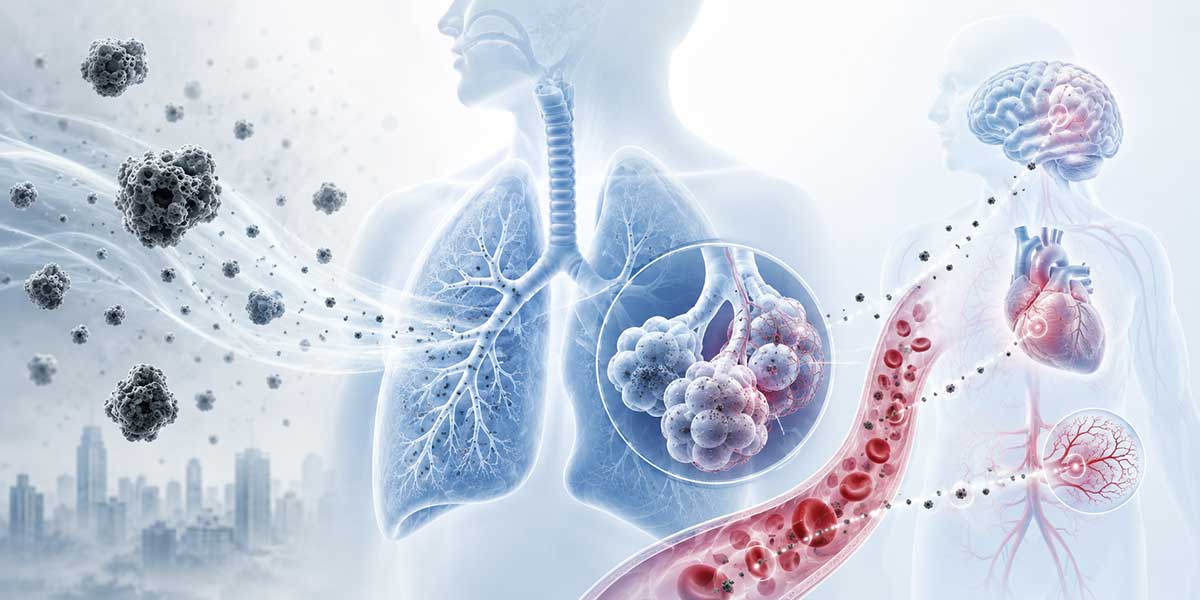
By breathing, we supply the body with oxygen, which is essential for life. Over the course of a day, we inhale approximately 12,000 litres of air, while simultaneously expelling around 0.7 kg of carbon dioxide (CO₂). However, we do not inhale gases alone. At the same time, various air pollutants enter the body. Among them, suspended particles play a particularly important role. One of the most hazardous groups of suspended particles is PM2.5. How PM2.5 particles affect health and what they actually represent is explained below.
1. What are PM2.5 particles and why are they specific?
PM2.5 particles represent a fraction of suspended particles in the air with an aerodynamic diameter smaller than 2.5 micrometres.
Importantly, aerodynamic diameter does not describe the actual size or shape of a particle. Instead, it refers to the diameter of an ideal spherical particle that behaves in airflow in the same way as the observed particle. This distinction matters because PM2.5 particles are not perfect spheres and do not have a compact structure.
On the contrary, they are typically irregular in shape, with numerous pores and cavities, resembling microscopic sponges.
As a result, PM2.5 particles can bind various substances present in the air onto their surface. Submicron particles, which form part of the PM2.5 fraction, are particularly significant because they have the greatest potential to penetrate deep into the body.
2. Are all airborne particles the same and equally harmful?
No. Not all airborne particles are the same, nor do they affect health equally – even when they share the same aerodynamic diameter.
PM2.5 is a classification based on particle behaviour in air, not on composition.
In practice, this means that particles of the same size can have entirely different properties and health effects.
For example:
- In coastal areas, a significant portion consists of sea salt aerosols
- Particles generated by combustion or industrial processes often contain heavy metals and organic pollutants
- Asbestos fibres released during demolition are particularly hazardous due to their structure and biopersistence
Therefore, assessing how PM2.5 particles affect health cannot rely on size alone. It must also consider chemical and biological composition.
3. Are microplastic particles also part of PM2.5?
In addition to well-known particles, the smallest fractions of microplastics are gaining increasing attention, as they can also fall within the PM2.5 spectrum.
Studies have detected microplastics in various parts of the human body, including the bloodstream, lungs, brain tissue, and even embryonic structures.
Importantly, exposure is not limited to food and water intake.
On the contrary, research increasingly shows that a significant portion of microplastics enters the body through inhalation.
This further confirms that the impact of PM2.5 particles cannot be understood solely through size – but also through composition and origin.
4. How do PM2.5 particles enter the body?
When inhaled, larger particles are retained in the upper respiratory tract.
However, PM2.5 particles reach the alveoli – the smallest structures in the lungs where gas exchange occurs. Gas exchange takes place across an extremely thin, almost single-cell membrane. The smallest particles can pass through this barrier and enter the bloodstream, where they travel throughout the body.
5. What happens after PM2.5 particles enter the body?
Once inside the body, PM2.5 particles can trigger oxidative stress, chronic inflammation, and damage to cellular structures. Because they enter the bloodstream, these processes are not confined to the lungs. Instead, they become systemic and affect multiple organs simultaneously.
6. What is the actual impact on health?
The impact is significant Data presented during the WHO webinar “Toxic air is fueling NCDs. Why are we not taking action?” show a consistent increase in disease risk with rising PM2.5 concentrations.
For every 10 µg/m³ increase in PM2.5:
- Dementia: +46%
- Childhood asthma: +34%
- Hypertension: +17%
- Stroke and COPD: +16%
- Myocardial infarction: +13%
- Type 2 diabetes: +10%
These findings clearly demonstrate that PM2.5 particles affect health systemically.
Does the list end here?
Unfortunately, no. The spectrum of health effects is much broader. Research also links PM2.5 exposure to hearing and vision disorders, thyroid dysfunction, autism, Alzheimer’s disease, Parkinson’s disease, and more.
SEE ALSO
Is there a connection between air pollution and hearing loss?
Air pollution and thyroid health – new scientific insights
Does polluted air increase the risk of autism?
How air pollution contributes to cataract formation
Overall, these findings indicate that inhaling PM2.5 leads to systemic health impairment. However, individual outcomes vary depending on factors that are not yet fully understood.
7. How do PM2.5 particles carry microbiological and chemical pollution?
One of the less intuitive but critically important aspects of PM2.5 particles is their role as carriers of other pollutants.
In this way, particulate pollution becomes a transport medium for both chemical and biological contaminants, including: bacteria and viruses, biological fragments, heavy metals, toxic compounds and oxides.
8. How are PM2.5 particles linked to antibiotic resistance?
A particularly important and still underexplored issue is the connection between PM2.5 and the spread of antibiotic resistance.
PM2.5 particles may contain elements that enable:
- transfer of resistance genes
- their spread through the environment
- exposure through inhalation
This topic will be explored in more detail in a dedicated article.
9. Why is understanding the mechanism of PM2.5 important?
Health effects of PM2.5 are often presented through individual diseases and statistics.
However, only by understanding the underlying mechanisms does it become clear how PM2.5 particles affect health as a whole. They do not act in isolation. Instead, they influence fundamental biological processes, which explains their wide association with various diseases.
10. How can we reduce PM2.5 intake?
We spend most of our lives indoors.
Estimates suggest that people spend around 90% of their time indoors, with approximately 65% spent at home.
This leads to a key conclusion:
Indoor air quality has a direct and long-term impact on total PM2.5 exposure.
Therefore, indoor conditions represent a factor we can significantly influence.
11. Does indoor air contain fewer PM2.5 particles?
Unfortunately, no.
In spaces without adequate ventilation and air purification, pollutant concentrations – including particles – are often higher than outdoors.
This results from limited air exchange, indoor pollution sources, and particle accumulation over time.
At the same time, outdoor air frequently fails to meet quality standards. According to the WHO, only about 1% of the global population lives in areas where air quality meets recommended guidelines.
Importantly, indoor particles do not originate solely from outdoor air – they are also generated indoors.
Humans themselves are a constant source. Research shows that a person can emit around 100,000 particles per minute at rest, and up to one million during movement.
Additional indoor sources include:
- cooking (especially frying and baking)
- combustion processes (fireplaces, solid fuel stoves, gas appliances)
- candles, incense, smoking
- cleaning and movement that resuspend settled particles
This combination explains why particles accumulate indoors over time.
What does this mean in practice?
Exposure to PM2.5 cannot be completely avoided.
However, understanding how PM2.5 particles affect health enables informed decisions about indoor environments.
Controlling air quality in the spaces where we spend most of our time is one of the most effective ways to reduce overall exposure.
Can air purifiers help?
Yes. Air purifiers can provide local improvement in the room where they are installed, although placement is important. However, they cannot remove CO₂ and typically do not affect nitrogen or sulphur oxides.
For long-term air quality and energy efficiency, systemic ventilation solutions with heat recovery and integrated air purification are preferred. These systems remove CO₂, reduce energy consumption, lower maintenance costs, cover all rooms.
Such solutions form the foundation of modern engineering approaches, including projects developed by Marquis Intelligence.
Conclusion
PM2.5 particles are not a single substance or isolated risk.
They represent a combination of:
- physical characteristics
- chemical composition
- biological properties
This combination enables them to affect the body systemically.
Understanding this impact forms the basis for a serious approach to health protection and air quality improvement.
Sources
- World Health Organization (WHO), webinar: Toxic air is fueling NCDs. Why are we not taking action? (2024)
- The Lancet Planetary Health (2023): Association between PM2.5 air pollution and antibiotic resistance
- University of Michigan – research on PM2.5 and dementia
- Wilker et al. – meta-analyses on air pollution and cognitive function
- Relevant studies on cardiovascular, respiratory, and metabolic effects
This article is part of the “Air Pollution and Health” series, in which Marquis Intelligence, as a socially responsible company, highlights the negative impact of polluted air on human health.
Document: MC-AP&H-014.26 – 11 Questions and Answers: How PM2.5 Particles Affect Health
