

Blog
Mini Case Study: Air Quality in a Café Where Smoking Is Allowed

Mini Case Study: Air Quality in a Café Where Smoking Is Allowed
In December 2025, the technical team at Marquis Intelligence faced one of its most demanding air quality projects to date: a café where smoking is permitted. Tobacco smoke that stings the eyes and nose. An unpleasant odor. Limited fresh air intake and real technical constraints of the facility required a complex solution – one that goes beyond standard ventilation approaches. In other words, improving air quality in a smoking-allowed café was anything but an easy task.
The project was defined through two implementation phases. The first was carried out in December 2025. The second in January 2026. In both phases, measurable and verified results were achieved.
This mini case study demonstrates how Marquis Intelligence, through a holistic engineering approach, achieved stable, long-term, sustainable air quality under real-world conditions in a café where smoking is permitted.
The Root of the Problem – Smoking and Tobacco Smoke
Tobacco smoke is a complex mixture of fine particles and gaseous pollutants. It contains suspended particles of extremely small size (PM2.5 and smaller), volatile organic compounds (VOC), carbon monoxide, and numerous other toxic components.
In enclosed spaces with limited fresh air supply, these substances remain trapped and accumulate. This creates pollution conditions that negatively affect health, comfort, and people’s ability to work. A particular challenge lies in the fact that tobacco smoke does not behave like an odor that can simply be “extracted” through ventilation. Tobacco smoke is a mixture of a large number of chemical compounds, some of which are highly harmful and toxic, as well as finely dispersed particles. An additional issue is the reduction of oxygen concentration and the increase of carbon dioxide concentration.
That is why such a space requires a targeted, multi-layer technical solution.
Legal Regulations Still Allow Smoking in Hospitality Venues
In hospitality spaces where smoking is allowed, the issue is not only the presence of smoke, but its retention within the space. The consequences include irritation of the eyes and respiratory tract, unpleasant odors, and reduced comfort for both guests and employees.
In this case, the café is located on the ground floor of a modern business building in New Belgrade. The amount of available outdoor air was limited. Increasing fresh-air intake through the building façade was not feasible. Standard ventilation did not deliver satisfactory results. During peak periods, tobacco smoke in the café caused stinging in the eyes and nose.
The project goal was clearly defined: real improvement of air quality—not merely formal compliance with technical requirements.
Regulatory Framework and Space Organization
In the Republic of Serbia, the legal framework related to smoking in indoor spaces is defined by the Law on the Protection of the Population from Exposure to Tobacco Smoke (“Official Gazette of the Republic of Serbia”, No. 30/2010). The law prescribes conditions and restrictions for smoking in public spaces, including hospitality venues.
In accordance with regulations, the organization of smoking and non-smoking zones plays a significant role in reducing exposure to tobacco smoke, especially for non-smokers. Therefore, the spatial position of the non-smoking zone in relation to the main entrance is important. It must be located right next to it, so that non-smokers are not forced to pass through the smoking zone where air pollution is more intense.
In this facility, the existing spatial organization did not follow this logic. An additional entrance was used more frequently. For that reason, it was designated the main entrance, and a non-smoking zone was established adjacent to it. However, this entrance represents an internal connection to the business building and, as such, should not have been treated as the main entrance.
Therefore, as part of the holistic technical solution, the positions of the smoking and non-smoking zones were modified in accordance with regulations and actual user movement patterns within the space.
Marquis Intelligence’s Holistic Approach
The existing technical solution was not satisfactory.
Marquis Intelligence applied its holistic approach, based on the 4D work matrix.
The application of the 4D matrix in this project included analyses of pollution sources (tobacco smoke), spatial airflows, system technical limitations, and real user habits.
The proposed and adopted solution included combining multiple technologies to improve air quality. Precise airflow analysis and careful positioning of intake and supply elements of the system were also implemented.
Special attention was paid to ensuring that air from the smoking zone does not re-enter the non-smoking area.
Phase One of the Project – Improving Air Quality in the Café
The Marquis Intelligence team ensured that the installation of air-quality improvement equipment would not compromise the venue’s interior design.
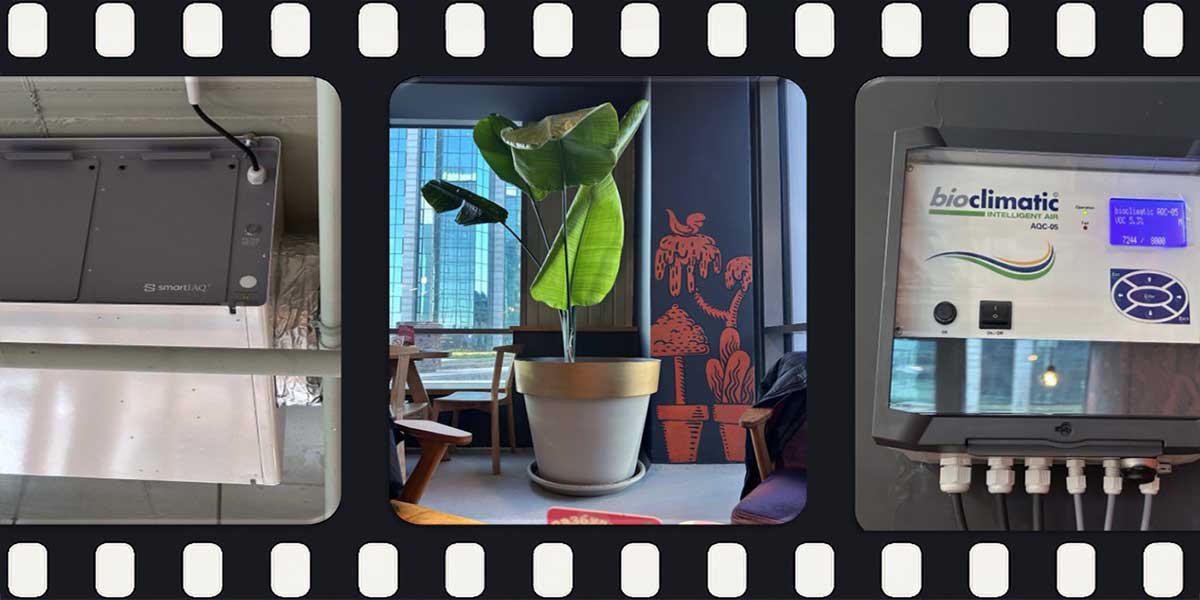
Within this project, a solution was implemented for the first time in Europe featuring an advanced system for continuous monitoring and control of air quality, adapted to the real operating conditions of a hospitality facility – Smart IAQ, from a U.S. equipment manufacturer.
In addition, air treatment using dielectric barrier discharge was implemented, provided by the German manufacturer Bioclimatic GmbH, with whom Marquis Intelligence has maintained a two-decade-long partnership.
See also: Partner par excellence – who and why
Phase Two of the Project – Improving Air Quality in the Café
Air quality in the café was already significantly improved in the first phase. Particles and a large amount of volatile organic compounds were eliminated. However, a lack of fresh air remained noticeable, as expected. For this reason, a second phase of the project was planned from the outset, with the goal of improving air quality in the smoking-allowed café while respecting the facility’s technical limitations.
As part of the second phase of implementation, the design, production, delivery, and installation of a portion of the ventilation system were carried out to supply an additional amount of fresh air treated by bipolar ionization.
Results in Practice
The effects were noticeable immediately after system commissioning. Unpleasant odors were eliminated. The subjective feeling of stuffiness disappeared. Air quality in the smoking-allowed café was visibly improved.
An employee who arrived first in the morning noticed that, unlike the previous musty smell, the air now felt “fresh, as if freshly washed laundry had been brought in.” The facility management confirmed that the smoke and odor issues no longer occur.
If the Goat Lies, the Horn Does Not
All visitors and employees come and go, but something remains constantly present in the interior—and suffered before the project was implemented. These are the potted plants.
The dominant plants in this space are bird-of-paradise plants (Strelitzia). Before the project was implemented, their growth had stagnated. For a long time, they produced no new leaves. And you cannot fool them.
People will come and leave. Some will catch the peak of a smoke-filled space, others will come when the entrance doors are wide open. They will have different impressions. However, plants that remain in the space at all times cannot lie.
A few weeks after the first phase went live, an indicative secondary effect of improved air quality was observed. The potted plants began developing new, large, healthy leaves. This effect appeared without any changes in plant maintenance.
As the saying goes: “If the goat lies, the horn does not.”
Maintenance and Long-Term Reliability
From the very beginning of the project, system maintenance was discussed. In settings such as this, long-term efficiency depends equally on the quality of the solution and the installed equipment, as well as on planned maintenance during operation.
Experience once again confirmed that general manufacturer recommendations are not sufficient for specific facilities. Full effects can only be achieved through engineering-customized solutions and continuous technical responsibility.
During equipment importation, Marquis Intelligence secured the necessary replacement molecular filters and maintains them in stock, along with all other potentially required spare parts.
See also: HVAC and IAQ System Maintenance – The Pillar of Reliability
Real-Time Measurements
Alongside the sophisticated equipment installed in this demanding air-quality environment, measurement and control systems were integrated to monitor air quality.
SmartIAQ is an intelligent air-purification system compliant with ASHRAE Standard 241-2023. It reduces total volatile organic compounds (TVOC), formaldehyde, PM1.0, PM2.5, PM4.0, PM10, and NOx. The system includes digital control and self-regulation via solid-state air-quality sensors that manage the flow rate of purified air.
Air purification via dielectric barrier discharge, applied in both project phases, also includes sensor control, and sensor measurements of volatile compounds are displayed on the controller.
All devices can be connected to the building’s BMS (Building Management System) upon user request.
Conclusion
This mini case study shows that air quality in a café where smoking is permitted can be improved, but it requires far more than standard ventilation or standalone devices.
Combining technologies, proper space organization, understanding airflow dynamics, and a methodological approach based on the 4D work matrix represents the key to success.
Client trust and clear, direct feedback from daily use of the space confirm the validity of Marquis Intelligence’s approach.
This text is part of the “Mini Case Studies” series by Marquis Intelligence.
Document ID: MI-MCS-06.1Q-26
Document title: Mini Case Study: Air Quality in a Café Where Smoking Is Allowed
