
Blog
Smog Threatens Health – Is There a Way Out?

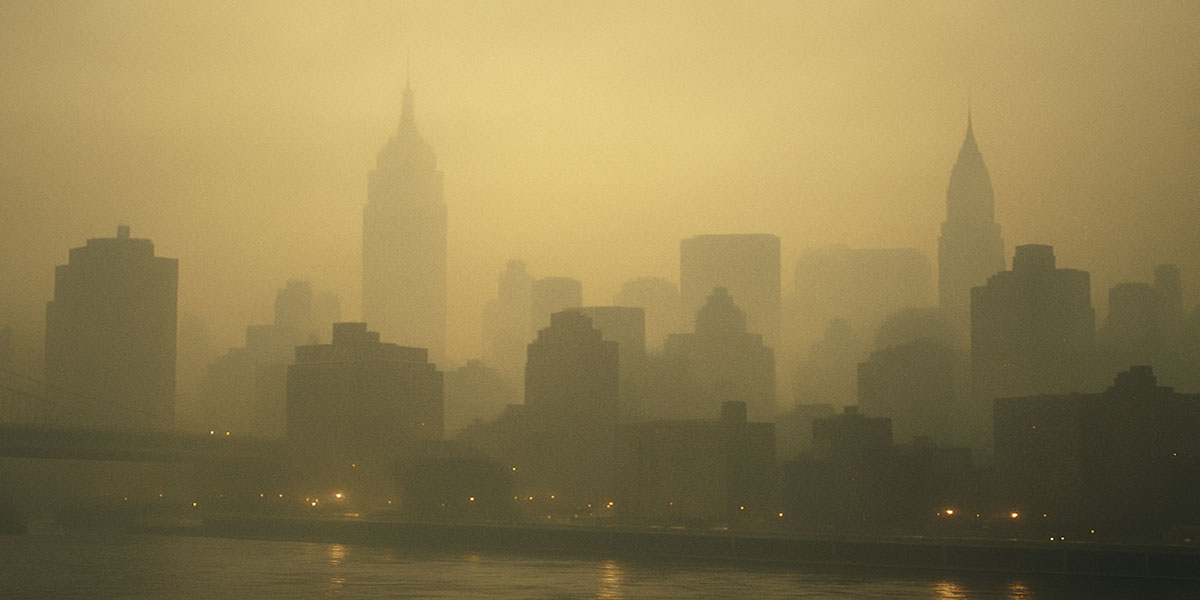
What exactly is smog? It is a state of the air in which polluting, often highly toxic substances, mix with water vapour. Such air usually becomes visibly hazy and heavy to breathe. What is most concerning, however, is that smog threatens health.
Modern smog, however, is not always visible, yet its presence still leaves a mark. Breathing in such air can cause a feeling of breathlessness and make respiration difficult, while long-term exposure increases the risk of serious illness.
The milder effects include irritation of the respiratory tract and worsening of asthma symptoms. More severe consequences, however, encompass chronic bronchitis, lasting damage to the lungs and heart, and even an increased risk of premature death.
Is Every Type of Smog the Same?
Not every smog is the same. It differs in composition and in how harmful it is to human health.
Still, the basic classification of smog includes two main types:
Classical – industrial smog was typical of the mid-20th century. It was a mixture of sulphur dioxide, smoke, and soot combined with moisture in the air – the smog that once choked the residents of London and New York.
Photochemical – the smog of modern society forms in today’s cities due to chemical reactions between nitrogen oxides, volatile organic compounds (VOCs), and water vapour driven by UV radiation.
Regardless of its type, smog remains a symptom of the same problem – polluted, unhealthy air. If the air is not purified correctly, it enters your home. In this way, smog threatens your and your family’s health.
The Great Smog of London
In December 1952, a dense, dark-yellow fog descended upon London. It was a toxic mixture of soot, Sulphur Dioxide, and moisture. The city was almost paralysed. Buses moved with the help of lamps and pedestrians guiding them through the streets. Trains stopped. People lost their way. Over the course of five days, more than 12,000 people lost their lives.
The event became known as the Great Smog of London.
When Marquis Intelligence published an article about the Great Smog of London on LinkedIn, a witness to the event, Alan Gregory, reached out to them. Today, he is a fire investigator specializing in kitchen ventilation ducts. At that time, he was just a boy, but he still vividly remembers those days. Moved by the Marquis Intelligence post, he wrote the following comment:
“I was in London then – I was eight years old – and watched as a man with a lamp led the buses through the streets. We lived in a shared house that burned coal.”
Read more about this event in an earlier Marquis Intelligence blog:
The Great Smog of London (1952)
History Repeats Itself Because People Don’t Learn from It
Smog threatens health, yet we continue to breathe it in, hoping it will have no consequences.
How many more times must we face a historical wake-up call?
History, they say, is the teacher of life. But repetition is the mother of knowledge.
Unfortunately, we don’t learn from our own air pollution disasters – we wait for them to happen again.
The Great Smog of London was meant to be not a warning, but an alarm – a reminder that such a tragedy should never be repeated.
But it wasn’t. We didn’t learn the lesson.
Today, we can clearly understand the causes and consequences of air pollution, and yet smog still exists.
People are still not fully aware of how vital clean air truly is.
Marquis Intelligence is among those who don’t wait for history to repeat itself – it learns from it, connects science with practice, and develops solutions that prevent the mistakes of the past from returning.
In a world where smog threatens health, Marquis Intelligence shows that accurate intelligence lies in recognising responsibility.
Smog in New York – A Repeated Scenario
Just a year later, in late November 1953, New York experienced a similar episode of smog.
Thousands of people complained of breathing difficulties, and an increase in mortality was recorded.
Yet even that experience was not enough to raise public awareness.
In November 1966, the situation repeated itself – but in a much more severe form.
Over three days, from 23 to 25 November, a warm air mass and a temperature inversion trapped a mixture of Sulphur Dioxide and carbon monoxide over the city.
The smog became so dense that visibility dropped dramatically. Breathing was difficult. Between 169 and 400 people lost their lives as a result.
It was the most severe air pollution episode in New York’s history.
The response to this environmental crisis came a few years later, with the establishment of the Environmental Protection Agency (EPA) in 1970.
Modern Smog – The Same Problem, New Sources
Today, under favorable meteorological conditions, the causes of smog extend far beyond chimney smoke.
Air pollution now originates from a wide range of sources, including transportation, heating, agriculture, waste, plastics, and even everyday household devices.
Photochemical smog is particularly evident in cities such as Los Angeles, Mexico City, and Beijing.
It forms through chemical reactions between sunlight, exhaust gases, and volatile organic compounds (VOCs).
Although the air often appears “clean,” concentrations of PM2.5 particles and ozone frequently reach levels that seriously threaten human health.
The sources have changed, but the consequences remain the same – smog threatens health, and clean air remains a fundamental condition for life.
Outdoor vs Indoor Air – Which Is More Dangerous?
Although outdoor air is increasingly polluted, what we often forget is that indoor air can be two to five times more polluted than outdoor air, according to the EPA.
At the same time, only a small percentage of people worldwide have access to outdoor air of satisfactory quality.
In reality, the air outside your home is likely of poor quality, and it enters uninvited each time you open your windows and doors.
Every home contains numerous sources of indoor pollution.
Building materials, cleaning agents, furniture, paints, varnishes, and even microplastics all contribute to indoor air contamination.
Insufficient ventilation allows these pollutants to accumulate, remaining in the air we breathe daily.
Ultimately, we inhale this polluted indoor air while believing we are “safe within four walls.”
Yet within those same walls, the average person spends around 65% of their life.
Homes Breathe – But What?
Natural ventilation, by opening windows and doors, often allows outdoor pollutants such as PM particles, nitrogen oxides, and allergens to enter our living and working spaces.
Under certain conditions, this can even contribute to local smog formation.
That is why it is important to remember that smog harms health.
What your house “breathes” – you breathe too.
Modern ventilation solutions are no longer a luxury but a necessity.
Marquis Intelligence designs and develops ventilation systems for residential buildings.
These systems protect you from outdoor pollutants, recover heat, and save both energy and household costs.
Most importantly, they ensure healthy air for you and your family.
Marquis Intelligence’s air purification solutions restore the natural balance of the spaces we live in.
See also: Residential Ventilation by Marquis Intelligence
See also: Mini Case Study: Apartment Ventilation in Belgrade
Repetition Is the Mother of Knowledge
From London’s Great Smog, through New York’s in 1953 and 1966, to today’s smog in Beijing and Delhi – smog changes its form, but not its consequences.
Smog threatens health, and health has no price. So why should clean air be a luxury?
Marquis Intelligence continues to research, analyze, and develop advanced ventilation solutions.
In doing so, it connects the past, present, and future of air quality – understanding that human health and sustainable design can never be separated.
Sources:
- The Great Smog of London, 1952 – UK National Archives
https://www.nationalarchives.gov.uk/education/resources/the-great-smog/ - Margaritoff, M. (2021, updated 2023). The Story Of The New York City Smog Of 1966 That Killed 200 People. All That’s Interesting.
https://allthatsinteresting.com/new-york-city-smog-1966 - S. Environmental Protection Agency (EPA): Air Quality Trends and PM2.5 Standards
https://www.epa.gov/air-trends - World Health Organization (WHO): Ambient (Outdoor) Air Pollution
https://www.who.int/news-room/fact-sheets/detail/ambient-(outdoor)-air-pollution - California Department of Public Health (2020): Wildfire Smoke and Toxic Exposure in Firefighters
https://www.cdph.ca.gov/Programs/EPO/Pages/Wildfire-Smoke.aspx
This text is part of the series “Learn More About Air Through History and People” from the archives of Marquis Intelligence.
Document: MI-LAH-008.25 – Smog Threatens Health – Is There a Way Out?
