

Blog
Damaged Asphalt – Invisible Environmental Consequences

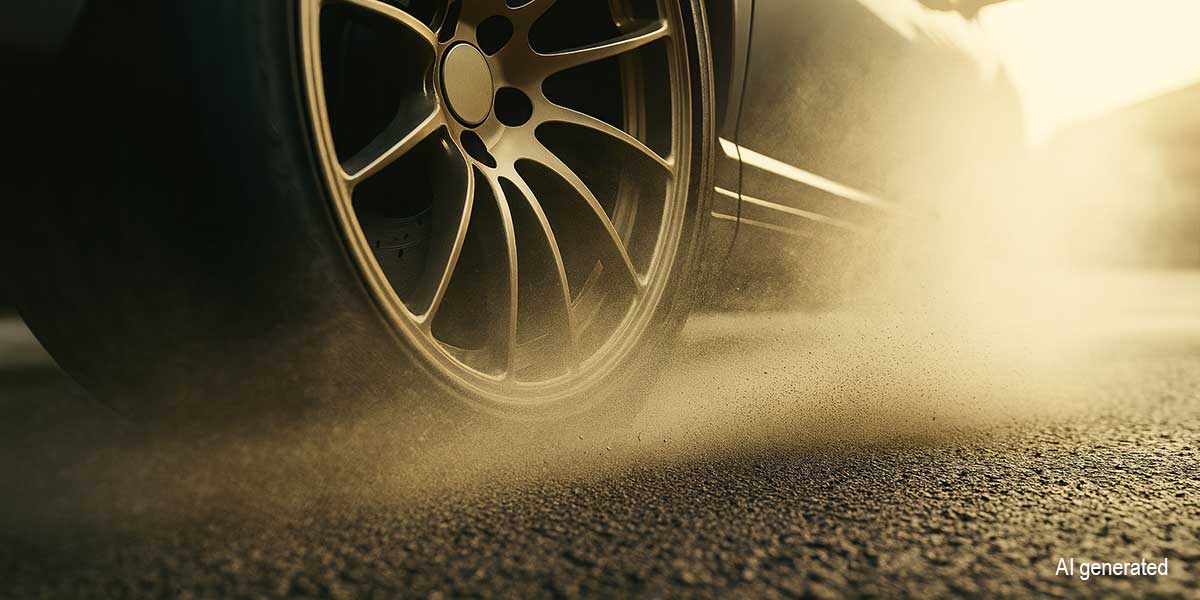
In recent days, the media has reported extensively on damaged asphalt surfaces near Ušće in Belgrade, Serbia. This raises an important question. What does damaged asphalt mean for the environment while waiting for repair?
Although road rehabilitation will undoubtedly follow, in the meantime, the damaged pavement becomes a source of additional emissions that affect air, water, noise, and fuel consumption. Not only here, but everywhere.
Tire and Pavement Wear
Uneven, rough asphalt significantly increases friction between tires and the road. The result is accelerated wear of both tires and the damaged pavement itself. On high-traffic sections, the release of particles is several times higher than on well-maintained surfaces.
These particles are known as tire-and-road wear particles (TRWP). They are a mixture of rubber, bitumen, and mineral components from damaged asphalt. They are particularly harmful because they are small, often within the PM10 and PM2.5 range, which means they easily penetrate the lungs and enter the bloodstream (Kole et al., 2017).
Non-Exhaust Emissions – The Hidden Part of the Problem
For decades, attention has been focused on tailpipe emissions. The engine technology advances, reducing. Unfortunately, the new emissions are becoming dominant – non-exhaust emissions. It comes from tires, brakes, and road wear. Today, it accounts for up to 75% of total PM10 from road traffic in European cities (EEA, 2020).
Damaged pavement further exacerbates this problem, as every uneven surface increases the number of particles released.
The Chemical Component: 6PPD and 6PPD-Q
Beyond mechanical particles, special concern arises from the additive 6PPD in tires. They react with ozone and form 6PPD-quinone (6PPD-Q). This compound has been scientifically proven to be acutely toxic to fish and has been detected in urban stormwater runoff (Tian et al., 2021).
This means that particles and chemicals from damaged asphalt may be washed into rivers after rainfall. Thus, the issue is not only about air – it is also about water.
Noise as a Signal
Drivers often notice that noise levels on damaged road sections rise significantly. The sound, like driving over road markings, is not only a comfort issue. It is an acoustic indicator of increased friction and energy loss (Sandberg & Ejsmont, 2002). Every extra decibel here means more particles released into the air.
Increased Fuel Consumption and Tailpipe Emissions
Another consequence often goes unnoticed. When asphalt is rough and rutted, vehicles need more energy to roll. This is measured by the International Roughness Index (IRI), expressed in meters per kilometer (m/km).
- Lower IRI (0.5–2 m/km) indicates smooth, efficient pavement.
- A higher IRI (4+ m/km) indicates poor condition and increased resistance.
Studies show that an increase of +1 m/km IRI results in 0.7–2% higher fuel consumption (FHWA). Multiplied by thousands of vehicles per day, this translates into substantial additional CO₂ and pollutant emissions.
Environmental Consequence: A Fourfold Burden
While waiting for repair, rutted asphalt creates a fourfold burden for the environment:
- Air pollution – through fine particles from tires, asphalt, and pavement degradation.
- Water pollution – as rain washes particles and chemicals into rivers.
- Increased exhaust emissions – due to higher resistance and fuel consumption.
- Excessive noise – as a direct result of uneven surfaces and higher friction.
A Tip for Drivers
When you hear increased tire scraping and road noise, slow down.
This will help you:
- Save your tires and fuel,
- reduce harmful gas emissions,
- protect both your budget and the environment,
- and additionally increase road safety.
The Ecological Footprint of Repair
It should not be forgotten that road repair itself carries an ecological footprint – from asphalt production and construction machinery to traffic congestion and temporary emissions during works. Still, we hope that with a new road surface, emissions will be reduced in the long run, resulting in a lower overall environmental impact. That would be a lasting benefit – for drivers and for the air we all breathe.
Our Social Responsibility
As a company dedicated to air purification, Marquis Intelligence believes it is essential to address such topics openly and impartially. Our goal is not sensationalism but raising awareness and sharing reliable information. We have previously written on similar current issues, for example, in our article on lithium. In that article, we sought to emphasize environmental consequences supported by scientific sources.
>> SEE ALSO: Potencijalni ekološki uticaj eksploatacije litijuma u Srbiji
Our social responsibility lies in monitoring issues that affect both the environment and human health and informing the public with scientifically grounded insights.
If the scientific articles we rely on turn out to be inaccurate, we are mistaken as well. In that case, we apologize.
Conclusion
This text is not a scientific study, but a reflection and an attempt to draw attention to the environmental dimension of damaged asphalt. A rutted road is not only a matter of driving comfort and safety – it simultaneously becomes a source of additional emissions that affect human health and quality of life in cities.
Sources and References
- European Environment Agency (EEA). Non-exhaust emissions from road transport (2020).
- Kole, P. J., Löhr, A. J., Van Belleghem, F., & Ragas, A. M. J. (2017). Wear and tear of tyres: A stealthy source of microplastics in the environment. Int. J. Environ. Res. Public Health, 14(10), 1265.
- Tian, Z., Zhao, H., Peter, K. T., et al. (2021). A ubiquitous tire rubber–derived chemical induces acute mortality in coho salmon. Science, 371(6525), 185–189.
- Sandberg, U., & Ejsmont, J. A. (2002). Tyre/Road Noise Reference Book.
- S. Federal Highway Administration (FHWA). International Roughness Index (IRI) and fuel consumption studies.
This article is part of the Marquis Intelligence series “Air Quality, Environment and Sustainability”, which addresses sources of pollution, as well as technical and technological solutions and their impact on air quality.
Document: MI-AES-005.25 – Damaged Asphalt – Invisible Environmental Consequences
