

Blog
Modern Air Pollution Regulation and Smog

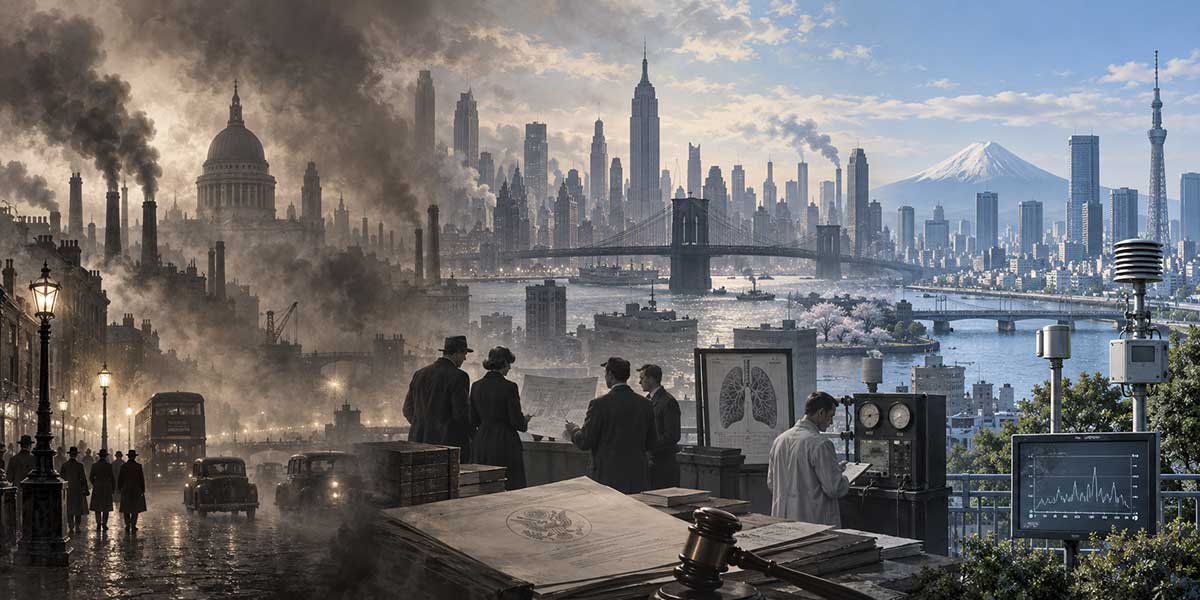
It is interesting to see how modern air pollution regulation developed rapidly under the influence of major smog episodes on three continents between 1952 and 1956.
These were not the years when the first air pollution laws were introduced. However, this period marked the beginning of a different approach. Air pollution was increasingly viewed not simply as a local problem involving smoke, soot, or individual industrial emissions, but as a public health issue requiring action by municipal, state, and national authorities.
Three Cities, Three Continents, Three Windows into Modern Air Pollution Regulation
London, New York, and Tokyo were among the most striking examples of the period. They faced different sources and levels of pollution. However, the underlying problem was similar. Large quantities of pollutants, particularly under unfavorable weather conditions, could become trapped over cities and seriously endanger public health.
Air Pollution Regulation Before 1952
The 1950s did not mark the beginning of legal air pollution control. One of the most important early examples was the British Alkali Act of 1863. The Act targeted hydrochloric acid emissions from the alkali industry of the time. It required at least 95% of the gas generated during the process to be condensed. It also introduced inspections of industrial facilities.
This legislation is important because it shows that technically defined requirements for reducing specific industrial emissions already existed in the 19th century. Various cities later introduced local regulations against smoke and soot. These generally targeted specific emission sources, particular industrial processes, or visible smoke.
What changed in the 1950s was not simply the existence of regulations. It was the way the problem itself was understood.
The Great Smog of London Changes the Perception of the Problem
From 5 to 9 December 1952, London was covered by exceptionally dense smog.
The burning of large quantities of coal, combined with emissions from industry and transport and unfavorable weather conditions, caused smoke, soot, and sulfur dioxide to accumulate in the air over the city.
The consequences could no longer be regarded simply as an inconvenience caused by smoke. Around 4,000 additional deaths were recorded during and immediately after the Great Smog. Later estimates indicated an even greater overall health impact. The UK Parliament today directly links the Great Smog with the legislative measures that followed.
SEE ALSO: The Great Smog of London (1952): Lessons from the Past
The Great Smog was not London’s first smog episode. Its scale, however, demonstrated that air pollution could have catastrophic health consequences for an entire urban population.
London’s First Legislative Response
The first significant legislative step followed less than two years after the Great Smog. The City of London (Various Powers) Act 1954 received Royal Assent on 5 July 1954, formally becoming law. The part of the Act dealing with pollution reduction prohibited smoke emissions from buildings within the City of London.
The City of London thus became the first local authority in Great Britain to prohibit smoke emissions throughout its entire territory. This was not yet a national air quality control system, but the direction was clear.
The UK Clean Air Act Changes the Approach at National Level
Exactly two years later, on 5 July 1956, the Clean Air Act 1956 received Royal Assent and became law. The UK Parliament describes it as the first Clean Air Act to apply across the United Kingdom and places it directly in the regulatory sequence that followed the Great Smog and the 1954 London legislation.
Among other measures, the Act enabled the establishment of “smoke control areas.”
It regulated dark smoke emissions and introduced measures that encouraged a transition towards fuels and combustion methods with lower emissions. This represented a significant change. Legislation was no longer focused solely on one chemical industry or an individual chimney. Urban air pollution was beginning to be addressed systematically
Smog in New York
Only one year after the Great Smog of London, New York experienced a serious air pollution episode in November 1953. A multi-day temperature inversion and stagnant air allowed pollutants to accumulate. Sulfur dioxide and smoke concentrations reached unusually high levels. A subsequent analysis of health data showed a statistically significant increase in mortality during the period associated with the event.
However, the American path towards air pollution regulation should not be linked to a single event. The catastrophic Donora smog in Pennsylvania in 1948, Los Angeles’ long-standing problems with photochemical smog, the London disaster of 1952, and other pollution episodes gradually demonstrated that the problem exceeded the capacity of individual cities to address it.
Air Pollution Enters U.S. Federal Legislation
On 14 July 1955, the United States adopted the Air Pollution Control Act of 1955. The U.S. Environmental Protection Agency (EPA) identifies it as the first federal legislation in the United States to address air pollution.
Its scope, however, should not be equated with that of the British Clean Air Act. The U.S. legislation primarily provided funding for research, data collection, the development of pollution reduction methods, and technical assistance to state and local authorities. Primary responsibility for controlling air pollution remained with state and local governments.
The EPA identifies the Clean Air Act of 1963 as the first federal legislation to establish a federal air pollution control program.
How Tokyo Initially Regulated Soot and Smoke
At almost the same time, a similar process was taking place on a third continent. During Japan’s post-war reconstruction, industrial growth brought increasingly serious pollution problems. In 1949, Tokyo became the first city in Japan to adopt the Tokyo Metropolitan Factory Pollution Prevention Ordinance, a local regulation designed to control pollution from industrial facilities. According to Japan’s Ministry of the Environment, the ordinance did not yet include quantitative standards.
By the mid-1950s, air pollution had become particularly severe.
Japan’s Ministry of the Environment states that smog caused by soot and the combustion of heating fuels frequently covered urban areas. In response, Tokyo adopted the Tokyo Metropolitan Soot Prevention Ordinance in 1955.
The ordinance introduced smoke-density control based on the Ringelmann scale. Stricter criteria applied in residential areas than in other parts of the city.
What Is the Ringelmann Scale?
The Ringelmann scale is one of the oldest methods for visually assessing the density of black smoke. An observer compares the appearance of smoke with standardized shades of grey and black. The shades are represented on a numerical scale, with higher numbers indicating darker and optically denser smoke.
The scale did not measure particle concentrations in the modern sense. However, it made it possible to replace the subjective observation of “a lot of smoke” with a more standardized criterion that could be used for regulation and enforcement.
From a Local Ordinance to Japan’s First National Law
The Tokyo ordinance was not a national law. Japan did not introduce its first national legislation controlling smoke and soot emissions until 1962. Nevertheless, the 1955 ordinance is important because it illustrates another characteristic of the development of modern air pollution regulation: the transition from a general prohibition of excessive smoke to a criterion against which emissions could be assessed.
What Connects London, New York, and Tokyo?
British, American, and Japanese regulations did not have the same legal status, scope, or regulatory mechanisms. It would therefore be inaccurate to present them as three parallel national laws adopted in three countries on three continents.
What connects them is something else. Within a very short period, it became clear on three continents that urban air pollution was more than a local smoke problem and required an organized regulatory response. It was no longer simply a matter of visible smoke, unpleasant odors, or dirty building façades. It had become a public health issue.
At the same time, elements that would later become integral parts of modern air pollution regulation began to emerge: research into health effects; monitoring; definition of permitted emission levels; controlled zones; inspections; standardized assessment methods; increasing involvement of government authorities.
For this reason, the period from 1952 to 1956 did not mark the beginning of air pollution regulation, but it represented an important turning point in the development of its modern form.
From Visible Smoke to Measurable Air Quality
Since the 1950s, both the sources of air pollution and the way we measure it have changed.
Black smoke and soot are no longer the only indicators of the problems associated with polluted air.
Modern air pollution regulation addresses both emissions from pollution sources and permissible concentrations of pollutants in ambient air. Today, authorities monitor concentrations of PM₂.₅ and PM₁₀, nitrogen dioxide, sulfur dioxide, ozone, and other pollutants. Regulations define limit and target values, measurement methods, monitoring locations, reporting obligations, and measures to be taken when air quality deteriorates.
This development continues today.
SEE ALSO: New EU Air Quality Regulations
Protecting Health as a Driver of Air Pollution Regulation
The emergence of modern outdoor air quality regulation was closely linked to the recognition of the harmful effects of air pollution on human health. Major smog episodes demonstrated how serious the consequences of exposure to high concentrations of pollutants could be.
Today, increasing attention is also being given to indoor air quality, where people spend around 90% of their time on average. The COVID-19 pandemic further highlighted the importance of ventilation in indoor spaces. However, indoor air quality involves a much broader range of pollutants and sources.
Marquis Intelligence and Air Quality Today
Today, it is no longer enough to conclude that air is clean simply because we cannot see smoke or detect an unpleasant odor. Many pollutants that affect health are invisible to the human eye. At the same time, indoor air quality depends both on outdoor air and on pollution sources within the building itself.
For this reason, when addressing indoor air quality problems, Marquis Intelligence follows the principle that the problem must first be identified. It must then be measured and confirmed, after which an appropriate technical solution can be selected. Once the solution has been implemented, the achieved results should be verified.
Depending on the problem and the building, the solution may include: ventilation; filtration; air purification; system control; air quality monitoring.
Technologies have changed significantly since the days when smoke density was assessed by comparing it with shades of grey on the Ringelmann scale. The fundamental principle, however, remains very similar: what we want to control must first be identified and measured, and the results of the implemented solution must then be verified.
This Marquis Intelligence article is part of the professional series “News from the World of Ventilation and Clean Air Standards.”
Document No.: MI-NewLegislation-008.26 – Modern Air Pollution Regulation and Smog
