

Blog
Healthy Air as Part of Sustainable Construction

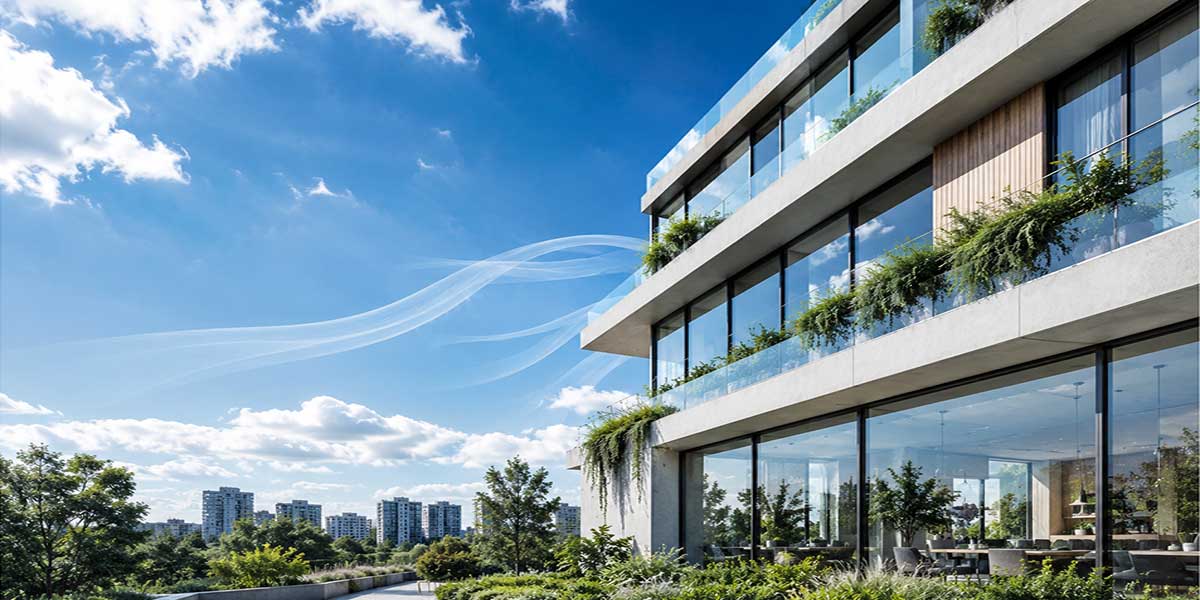
Healthy air as part of sustainable construction is not a new topic for Marquis Commerce and the Marquis Intelligence brand. It is a professional direction the company has been developing for years through engineering solutions, market education, expert lectures, and practical work focused on indoor air quality in buildings of various purposes.
The company has renewed its membership in the Serbia Green Building Council (SrGBC), which the Council also announced on its official website.
“For us, this return is not merely a formal renewal of membership, but a continuation of a professional path that began in the early years of the Council’s work,” emphasizes Vladimir Janaćković, CEO of Marquis Commerce.
Membership Since the Early Years of the Council
Marquis Commerce was part of the SrGBC community from its early days. Membership and active participation continued until the COVID-19 pandemic period.
“Today, we are returning to that community with the same core idea, but in a more contemporary context: green construction must also include what building occupants breathe every day,” notes Vladimir Janaćković.
Through Marquis Intelligence, our professional focus remains on solutions that connect ventilation, air purification, indoor air quality control, energy efficiency, and healthier indoor environments.
Returning to the Council
The Serbia Green Building Council plays an important role in promoting sustainable construction, transforming the construction sector, and raising awareness about the importance of buildings that are energy-efficient, responsibly designed, and better for the people who use them.
In this sense, the return of Marquis Commerce to the Council represents a natural continuation of previous engagement. The company’s relationship with SrGBC has been built over many years – through membership, institutional participation, professional lectures, events, and educational activities.
Vladimir Janaćković, Director of Marquis Commerce, participated for years in the work of the Council’s Board of Directors. Additionally, through expert content and participation in various events, the company contributed to topics connecting green construction, indoor environmental quality, and occupant health.
The renewed membership is therefore not the beginning of a new story, but the continuation of Marquis Commerce’s long-standing professional commitment to sustainable construction topics.
Healthy air as part of sustainable construction has always been – and remains – an important element of sustainability in the building sector. Because if the air inside a building is poor, the building cannot truly be good for people.
Why Is Air Part of Green Construction?
When discussing green construction, people usually first think of energy efficiency, water consumption, material selection, renewable energy sources, emission reduction, or certification systems. All of these are important elements of sustainable buildings.
However, there is one less visible element that directly affects quality of life in every building: the air we breathe.
Buildings are not designed only to consume less energy. They are designed for people. Therefore, sustainability cannot be separated from indoor environmental quality, comfort, health, productivity, and occupant safety.
Indoor Air Quality as Part of Indoor Environmental Quality
When discussing sustainability and indoor environmental quality, two important terms are:
- IEQ – Indoor Environmental Quality
- IAQ – Indoor Air Quality
IAQ is one of the key components of IEQ. It includes the quality of the air occupants actually breathe, including ventilation, filtration, pollution control, odors, VOC compounds, particles, microbiological contamination, and other factors affecting health and comfort.
That is why indoor air quality is not an addition to green construction. It is one of the conditions required for a building to truly be good for the people inside it.
Earlier Contributions to the SrGBC Community
Marquis Commerce addressed topics related to air quality, green standards, and healthy buildings long before terms such as IAQ, IEQ, ESG, or “healthy buildings” became common in business communication.
- In 2011 in cooperation with the Serbia Green Building Council, Marquis Commerce organized the lecture: “Indoor Air Quality, Its Ionic Composition, and Its Impact on Human Comfort and Health.” The lecture covered topics related to air quality, the impact of ionic composition on comfort and health, as well as LEED standard requirements related to air quality.
Even at that time, Marquis Commerce presentations connected topics such as green construction, certification, LEED, indoor environmental quality, and indoor air quality. This demonstrates that, for us, air has always been an integral part of discussions about green buildings – not a separate technical topic. - In 2012 at the Serbia Green Building Expo in Belgrade, Gordana Blagić from Marquis Commerce delivered the presentation: “The Highest Indoor Air Quality Through Bipolar Ionization-Based Air Purification.” This presentation further confirmed the continuity of professional engagement in advanced air treatment methods, reduction of microbiological, chemical, and physical pollution, VOCs, formaldehyde, odors, and fine particles.
- In 2013 SrGBC and Marquis Commerce organized the seminar: “Air Quality in Modern Interiors.” The seminar focused on indoor air quality, modern interiors, comfort, productivity, health, and green building standard requirements related to these topics.
This continuity demonstrates that Marquis Commerce did not join sustainable construction topics later on. On the contrary, the company contributed from the Council’s early years to understanding one of its key – but often insufficiently visible – segments: air.
A Topic Once Ahead of Its Time
More than ten years ago, discussions about indoor air quality within the context of green construction were much narrower than they are today. The focus was mainly on energy balances, materials, standards, and certifications. Air quality appeared as part of technical criteria, but in practice often lacked the visibility it deserved.
Today, the situation is different.
Healthy buildings, well-being, ESG, EPBD, SDG goals, and indoor environmental quality are increasingly becoming part of the language of investors, designers, occupants, and regulatory frameworks. What was once a topic for a narrow circle of experts is now becoming one of the key questions of modern construction.
How Can Buildings Consume Less Energy While Providing Better and Safer Conditions for People?
For Marquis Intelligence, the answer is not choosing between energy efficiency and health. The answer lies in engineering solutions that achieve both goals.
This is precisely where Marquis Intelligence sees its most important contribution.
EPBD, ESG, and SDGs: A Modern Framework for the Same Topic
The modern European framework for building energy performance, including EPBD, increasingly connects energy efficiency with indoor environmental quality. This is an important shift because it confirms that buildings cannot be evaluated only through energy consumption, but also through the conditions they provide to occupants.
SEE ALSO: EPBD 2026 and Indoor Air Quality – If the Air Is Poor, the Building Is Poor
SEE ALSO: EPBD: Energy-Efficient Buildings Must Have Healthy Air
Within the ESG framework – Environmental, Social, and Governance – indoor air quality naturally belongs. It is not merely a technical system issue, but also a matter of human health, occupant comfort, work performance, energy responsibility, and long-term building value.
The same applies to the Sustainable Development Goals (SDGs). Contributions depend on building type and project goals, with focus areas defined according to real needs, technical possibilities, and measurable parameters.
In practice, ventilation, air purification, and air quality control solutions can contribute to health, energy efficiency, sustainable cities, innovation, and climate-responsible design.
Ventilation, HRV, and Real Building Sustainability
In modern buildings – especially those with high energy efficiency requirements -ventilation is becoming increasingly important. A well-insulated building may have low energy losses, but if the air is not controlled, filtered, and properly treated, occupants may still be exposed to poor indoor air quality.
The More Energy-Efficient the Building, the More Important Ventilation Becomes
Modern buildings are increasingly insulated and airtight. This reduces energy losses but simultaneously increases the importance of controlled ventilation. Energy efficiency must not mean sealing buildings at the expense of air quality. True sustainability begins when a building consumes less energy while simultaneously providing a healthy, comfortable, and controlled indoor environment.
Ventilation is therefore not only a matter of airflow quantity or air change rates. It is also about air quality, filtration, distribution, comfort, noise, drafts, energy consumption, and system maintenance. It is precisely within this integrated approach that Marquis Intelligence sees its contribution to green construction.
Heat Recovery Ventilation
That is why heat recovery ventilation (HRV) is not a luxury, but an important part of responsible design. It enables the supply of fresh air while reducing energy losses. When combined with appropriate filtration, air purification, and automatic control, HRV becomes one of the key elements of healthy, comfortable, and sustainable buildings.
Natural ventilation may have its place, but in urban areas and regions with polluted outdoor air, it is not always sufficient. Opening windows does not guarantee healthy air. In many cases, it results in energy loss and uncontrolled entry of outdoor pollutants.
Healthy Air as Part of Sustainable Construction
This is why Marquis Intelligence develops and implements solutions that include:
- heat recovery ventilation,
- air filtration,
- indoor air purification within HVAC systems,
- exhaust air treatment where required,
- optimization of system operation according to actual building needs.
This approach does not treat air as an isolated technical parameter, but as part of a broader system involving the building, occupants, energy, health, and responsible space management.
How Can Marquis Commerce Contribute to the SrGBC Community?
“Renewing our membership in the Serbia Green Building Council is an opportunity for us to continue where our earlier engagement ended—but in a new context and with more modern tools,” says Vladimir Janaćković.
Going forward, the company aims to contribute to the SrGBC community through:
- exchange of professional knowledge,
- practical examples and project experience,
- case studies,
- educational articles,
- participation in professional discussions,
- and a potential webinar on the connection between green construction, IAQ, HRV, EPBD, ESG, and healthy buildings.
The goal is not only to promote technology, but above all to expand understanding that sustainable construction does not end with energy classes, material selection, or formal certification. It must also include what building occupants breathe every day.
In the field of air quality, equipment alone is not enough. It is necessary to understand the building, pollution sources, usage regimes, user requirements, system capabilities, and the consequences of every technical decision. That is why knowledge is just as important as technology.
Healthy Air and Green Construction
The return of Marquis Commerce to the Serbia Green Building Council represents a logical continuation of a professional direction we have been developing for years. Through Marquis Intelligence, that direction today takes a modern form: healthy, controlled, and energy-responsible indoor environments.
Green construction is not complete without healthy air.
That is why we believe indoor air quality should become a much more visible part of discussions about sustainable construction – not as an additional option, but as one of the fundamental conditions for buildings to truly be good for people, communities, and the future.
Because what we do not see often has the deepest impact on how we live.
This text is part of a publication series presenting the work and business results of Marquis Intelligence.
Document number: MI-PROM-26.021 – Healthy Air as Part of Sustainable Construction
