

Blog
PFAS or forever chemicals – nonsense or threat?

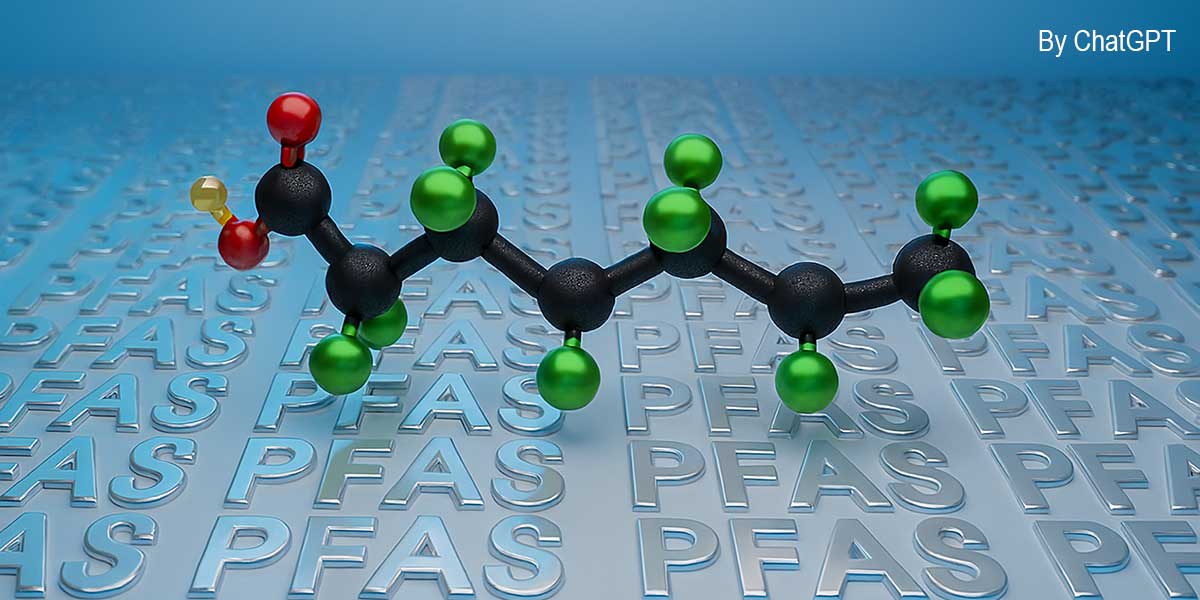
What are PFAS, or forever chemicals?
PFAS sounds like a bad word, but what does it actually mean? It refers to a group of chemicals that deserve our full attention. PFAS or forever chemicals represent more than 15,000 different synthetic substances, known as per- and polyfluoroalkyl substances. They have been used worldwide since the 1950s and are now considered one of the most prominent pollutants of modern civilization.
Thanks to the extremely strong bond between carbon and fluorine, PFAS chemicals have exceptional chemical and thermal stability, making them resistant to oxidation, UV radiation, and biological degradation. Additionally, they possess water- and oil-repellent properties, which is why they have found widespread use – but have also become extremely persistent pollutants that remain in both the environment and the human body for decades.
Are PFAS, or “forever chemicals,” used daily?
Unfortunately, yes. PFAS chemicals lurk in many of the products we use daily. They can be found, for example, in the following products:
- non-stick pans and other cookware (Teflon),
- materials for packaging and serving food, such as coated cardboard boxes, plastic cups, straws, etc.,
- water-, oil-, and stain-resistant textiles,
- various cosmetic products and their packaging,
- household and industrial appliances,
- electronics – phones, computers, tablets,
- firefighting foams,
- and even in medical equipment.
You cannot see or taste these substances. But you almost certainly already carry them inside you.
Do PFAS, or “forever chemicals,” enter our bodies?
People are most commonly exposed to PFAS through contaminated food and water, but the latest scientific findings confirm that they also enter the body through the air. They enter the food chain through cookware and packaging that contain them. Additionally, exposure occurs:
• through the skin, via cosmetics and household products,
• by inhaling PFAS present in the air – either bound to PM2.5 particles or in volatile form,
• in work environments, especially in the fluorochemical industry.
PFAS, or forever chemicals, are a global public health issue
Forever chemicals are present in water, air, soil, plants, animals, and the human body.
They have been detected in the bodies of every person tested in Europe, including fetuses.
PFAS chemicals have become a global public health issue. Exposure to them has been linked to:
- certain types of cancer,
- hormonal disorders,
- reduced fertility,
- immune system damage,
- type 2 diabetes and other chronic diseases.
For a long time, it was believed that the main routes of PFAS intake were food and water. However, recent research has shown that PFAS are increasingly inhaled, as they bind to fine PM2.5 particles that reach deep into the lungs, while the tiniest so-called ultrafine particles from the air enter the bloodstream. In this alliance with PM2.5 particles, PFAS may be linked to a wide range of other diseases – heart attack, stroke, asthma, mental illness, and many others.
PFAS is transferred from the mother to the fetus
Scientists have proven that PFAS chemicals are transferred from the mother to the fetus through the placenta and to the newborn through breastfeeding. This fact further heightens concern about the presence of PFAS in everyday environments – even during the prenatal stages of life.
A cocktail of poisons: PM2.5 and PFAS
PM2.5 are particles with a diameter smaller than 2.5 micrometers. They are small, but extremely harmful.
When PFAS bind to them, a toxic aerosol forms that is easily transported through the atmosphere and penetrates deeply into the body.
Even more alarming: there is no safe dose of exposure – even small concentrations of PFAS on PM2.5 particles pose a health risk.
This combined effect is increasingly drawing the attention of the scientific community. According to a study published in the journal Environmental Science & Technology (DOI: 10.1021/acs.est.5c07694), detection of PFOA (one of the PFAS chemicals) in bound form to PM2.5 in urban areas indicates a serious potential health risk. The authors call for broader research and more precise toxicological and epidemiological analysis of these compounds.
EU initiative to ban PFAS chemicals
The European Union has launched one of the most ambitious initiatives to date – a ban on more than 10,000 PFAS substances under the REACH regulation (Registration, Evaluation, Authorization, and Restriction of Chemicals). This initiative envisions the gradual phase-out of PFAS use in various sectors – except where no alternative exists.
In January 2023, five European countries (Germany, the Netherlands, Denmark, Sweden, and Norway) jointly submitted a proposal to the European Chemicals Agency (ECHA) to restrict all PFAS in the EU as a group, due to their toxicity, persistence, and bioaccumulation.
The final decision on restricting PFAS substances is expected in 2025, following public consultations and scientific evaluation. If adopted, it will be the largest substance ban ever implemented under EU chemical legislation.
And while there is no legal limit on PFAS, or “forever chemicals” (yet), there is one on PM2.5.
SEE ALSO: Environmental Protection Agency, EPA, USA reduces the permissible concentration of harmful particles in the air with a new standard
SEE ALSO: New EU air quality regulations
How is air pollution with PM2.5 particles regulated?
Given the serious health effects that PM2.5 particles cause – including the possibility of carrying PFAS chemicals – their concentration in the air is legally regulated.
However, the regulations vary:
- 25 µg/m³ – Serbia
- 10 µg/m³ – EU
- 9 µg/m³ – USA (EPA recommendations)
- 8 µg/m³ – Australia
- 5 µg/m³ – World Health Organization (WHO) recommendation
Despite the WHO’s recommendation, the allowed concentration in Serbia is five times higher, meaning the population is additionally exposed to invisible but serious dangers.
How to protect yourself?
Although an individual cannot completely avoid exposure to PFAS chemicals, the following measures can reduce the risk:
- avoid using non-stick cookware unless labeled PFAS-free,
- Use glass or stainless steel containers for food storage.
- choose natural textiles instead of water- or stain-resistant materials,
- Read the ingredients in cosmetics and avoid products labeled “fluoro” or “PTFE.”
- purify your water,
- use ventilation with good filtration, and air purification.
Sources:
- Environmental Science & Technology, Viewpoint, July 18, 2025, DOI: 10.1021/acs.est.5c07694, https://pubs.acs.org/doi/10.1021/acs.est.5c07694
- The Guardian, June 19, 2025: https://www.theguardian.com/environment/2025/jun/19/world-worst-case-of-pfas-forever-chemicals-contamination-kallinge
- The Scientist: https://www.the-scientist.com/pfas-exposure-and-health-effects-72472
- OECD PFAS Global Database: https://www.oecd.org/en/topics/sub-issues/risk-management-risk-reduction-and-sustainable-chemistry.html
- ECHA – European Chemicals Agency: https://echa.europa.eu/information-on-chemicals
- https://newsinhealth.nih.gov/2025/01/what-are-pfas
This article is part of the Marquis Intelligence series “Air Quality, Environment and Sustainability”, which addresses sources of pollution, as well as technical and technological solutions and their impact on air quality.
Document: MI-AES-004.25 – PFAS or forever chemicals – nonsense or threat?
