

Blog
Decentralized Ventilation Systems in the Home: Advantages and Limitations of Application

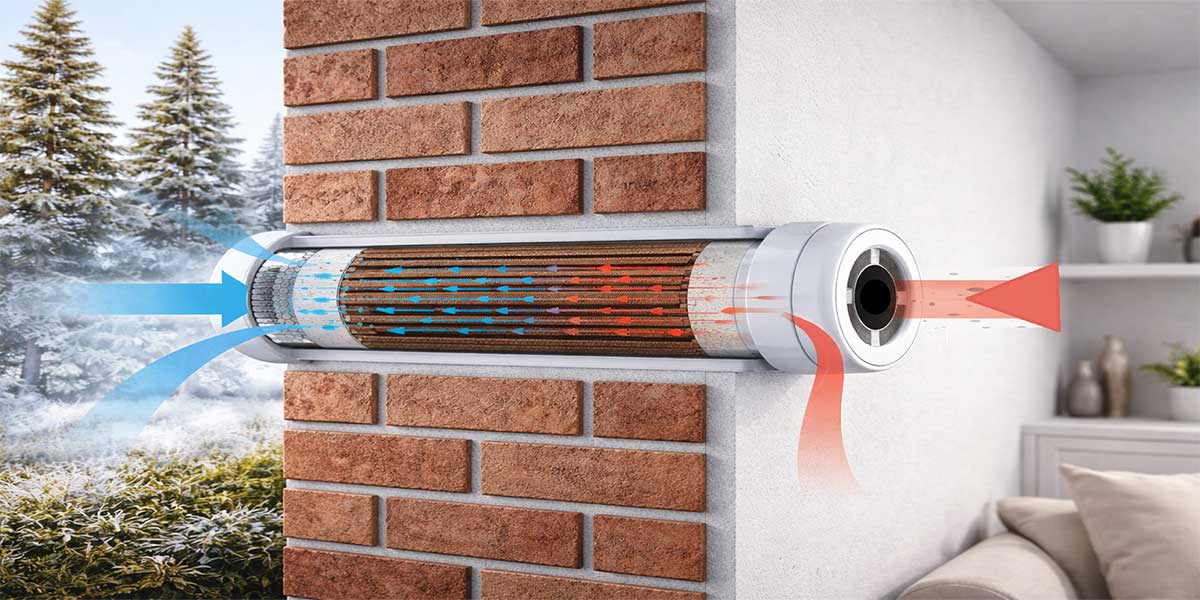
Decentralized ventilation systems in the home are often presented as a simple and practical solution. However, their actual technical capabilities, limitations, and conditions of application are rarely or reluctantly considered.
It is also commonly assumed that such systems are more cost-effective than central ventilation systems. This, however, is not necessarily true. The total cost depends on the number of required units, installation complexity, electrical works, maintenance, and the specific technical requirements of the space.
In many cases, decentralized ventilation can be a justified solution, particularly where a central ventilation system cannot be installed or is not economically viable. At the same time, it is important to understand that these systems have significant limitations and are not equally suitable for every building or every room.
What Are Decentralized Ventilation Systems in the Home?
Decentralized ventilation systems in the home are based on multiple individual ventilation units, typically with heat recovery.
These units are installed locally, most often within the external walls of the rooms being ventilated. Together, multiple units form a decentralized ventilation system intended to ventilate the building.
In practice, units are often installed in pairs or groups to ensure a meaningful airflow direction through space.
Are All Decentralized Ventilation Systems the Same?
No. Decentralized ventilation systems in the home include several technically different solutions. The key differences relate to airflow principles and the construction of individual units. Regardless of the type, decentralized systems share certain characteristics that directly influence their application potential.
Common Technical Characteristics and Limitations
The capacity of individual units is limited and, in most cases, corresponds to the needs of a single room. This limitation is dictated by the unit’s construction. Higher airflow rates require larger devices, which impact architectural and structural design.
Therefore, the required total airflow in a building is achieved by installing multiple units distributed across rooms.
Their application is limited in spaces with high pollution loads, where continuous and controlled air extraction is required.
These characteristics define the practical applications of decentralized systems and form the basis for understanding their advantages and limitations.
1. Single-Fan Wall Units
These are the most used devices installed on external walls. The unit consists of a tubular casing containing a heat-recovery core, filters, and a fan that periodically reverses direction. During operation, one phase supplies fresh air, and the other phase extracts indoor air.
Heat transfer occurs through the core, which accumulates heat from exhaust air and transfers it to incoming air when airflow reverses. The cycle typically changes every few minutes.
Key characteristics:
- alternating (not continuous) airflow
- fluctuating pressure conditions (positive/negative)
- need for paired operation to maintain balance
Due to cyclical airflow reversal, these devices do not maintain a stable negative-pressure regime, which is essential for reliable air extraction.
2. Dual-Fan Wall Units
These units use separate fans for supply and exhaust air. Air flows simultaneously and continuously through a heat exchanger (typically plate-type), with separated airflow paths.
Key characteristics:
- continuous and more stable airflow
- clearly separated supply and exhaust streams
- no air mixing within the unit
Technically, these devices are closer to central systems, but they remain local solutions intended for individual rooms.
3. Floor and Parapet Units
In addition to wall units, floor-standing and parapet units also exist. Their effect is generally limited to a single room.
Depending on the manufacturer, the unit may include heating or cooling functions for the air supply. Unlike reversible units, they provide continuous airflow direction.
Where Do Decentralized Ventilation Systems Have an Advantage?
Decentralized systems are particularly useful in existing buildings where central systems cannot be installed due to structural limitations, such as thick partition walls or low ceiling heights.This is especially relevant in renovations and older buildings where duct installation would be complex or economically unjustified.
Their advantage lies in less invasive installation inside the building. However, façade works are typically more extensive than with central systems. Centralized systems require two openings (façade or roof). Decentralized systems require one opening per unit. Condensate drainage must also be addressed for each unit, even if quantities are small.
Importantly, a simpler installation does not automatically mean a better technical solution.
SEE ALSO: FAQ – Home Ventilation
Often Overlooked Limitations
Decentralized systems depend on each room having access to an external wall. Rooms without façade access cannot be easily ventilated.
Wall thickness must also be sufficient for installation.
Attempts to connect internal rooms via ducts increase pressure drop and reduce airflow, often beyond these devices’ capacity.
Each unit also requires a power supply, which is often overlooked but essential for users to understand.
Impact of External Conditions and Operational Stability
According to the “EwWalt” research project (RWTH Aachen), units with alternating operation can be sensitive to external pressure changes, especially wind.
Due to axial fan characteristics, airflow may decrease under unfavorable conditions, and effective airflow can be about 15% lower than in continuous systems.
System performance depends on installation conditions and external influences.
(Source: REHVA Journal, EwWalt research project – Energetic assessment of decentralized ventilation units with alternating operation)
How do decentralized home ventilation systems affect the building’s façade?
Installation openings are not small – typically 150-200 mm in diameter. When repeated across multiple rooms, the impact becomes technically and aesthetically significant.
In practice, this can be the deciding factor. In one case in Belgrade, the owner of an architectural studio in a luxurious villa considered installing a decentralized ventilation system. After analyzing the required number of devices and the layout of openings on the facade, he gave up on the investment.
These solutions are not suitable for all types of façades. For example, they are not applicable to fully glazed façades or certain lightweight façade systems.
Air Purification in Decentralized Systems
In decentralized ventilation systems, air purification is, in most cases, limited to mechanical filtration. The use of molecular filters with smaller capacities is possible, but in practice it is rare.
Due to the limited available pressure of the fan and the device’s compact design, the use of more advanced air purification technologies is generally not feasible.
This means that air quality remains largely dependent on outdoor air quality and basic filtration. Considering that only 1% of the world’s population breathes outdoor air that meets World Health Organization (WHO) health guidelines, this represents an additional limitation. (Source: World Economic Forum, based on WHO data)
Energy Efficiency of Decentralized Ventilation Systems
Decentralized ventilation systems with heat recovery are a better solution than ventilation without recovery (e.g., only fans for air intake and exhaust or natural ventilation by opening windows and doors). However, they are generally less energy efficient than well-designed central home ventilation systems.
Although individual units consume little energy, the total system often includes many units, which can increase overall consumption.
Maintenance of Decentralized Systems
Centralized systems are maintained at a single location; decentralized systems require maintenance at each unit. That means entering every room, replacing multiple filters, and cleaning multiple heat exchangers. This increases the time and cost of system maintenance.
Due to limited pre-filtration, heat exchangers become dirtier faster, while micro-condensation accelerates particle accumulation. In practice, the maintenance costs of decentralized systems are often underestimated, whereas those of centralized systems are generally lower and easier to control.
SEE ALSO: HVAC and IAQ systems Maintenance– a pillar of reliability
The Marquis Intelligence approach to ventilation system selection
In practice, the choice between a decentralized and a centralized ventilation system is not based on the type of device but on the actual needs of the space and the facility’s technical capabilities.
Marquis Intelligence bases its analysis on space function, pollution and humidity load, architectural constraints, and air quality requirements.
Based on this, it is defined whether it is possible and justified to implement a central ventilation system or whether a decentralized approach is an acceptable solution.
The goal is not to choose a specific type of system, but to achieve stable, controlled air quality in space while respecting all technical and operational factors.
When Does Decentralized Ventilation Make Sense?
Decentralized systems are justified mainly where central systems cannot be installed – especially in renovations and older buildings.
Their key advantage is simpler installation. However, this must always be evaluated alongside: limited capacity, need for multiple units, façade impact, more complex maintenance, and limited air purification. These factors define their real application.
This text is part of the Marquis Intelligence professional series “Home Ventilation”.
Document: MI-HV-008.26 – Decentralized ventilation systems in the home: advantages and limitations of application
